Showing posts with label p. Show all posts

11 February 2011

The Prisoner of Shark Island


I didn't know until just now that this was based on the true story of Dr. Samuel A. Mudd, but of course it is. It's too grand and bizarre and interesting a story to be otherwise. I was about to suggest that it might also explain some of the stranger directions the story goes in, most notably the attempted-but-thwarted escape sequence, but according to Wikipedia, that's all made up, it turns out. Still, this is a pretty exciting film, and damn impressive for 1936 in terms of action and drama.

I made a point to watch this when reading Samuel Fuller talk about Shock Corridor and being visited by Ford and calling him "the man who made the great Prisoner of Shark Island," and I can definitely see how the claustrophobia and madness inherent to the fort made an impression on Fuller's film years later.

The structure is a little odd, taking forty-plus minutes to get the prisoner onto shark island and all, and then spending the next thirty or so with his wife's scheme to storm the castle and bring her man back to Key Largo for a new trial -- which works until their ship is boarded (and her father murdered, no less). Considering this was Dr. Mudd's story primarily, I'm surprised this whole sequence occurs. I mean, I'm glad Mrs. Mudd wasn't portrayed as sitting at home wringing her hands and waiting for a miracle, but other than showing how hard it is to escape, it seemed to be a massive, needlessly complicated dead-end that had nothing to do with the final act's action. Then again, I guess you can't really put an innocent dude in a prison called Shark Island and not have a long daring escape sequence.

But aside from the dead-ends and long side-stories, I was pretty impressed. Dr. Mudd looks haunting with his skinny body, wild hair, and shaggy beard, but commanding with his half-buttoned dress shirt and funny little mustache. A lot of scene-stealingly great character actors (including John Carradine among them) populate the sidelines throughout, which helps the world feel lived-in and interesting.

My only comment left is the music. The "score" was primarily made up of variations on two songs. "Dixie" I understand, though it didn't always work. On the other hand, the love-theme and tragic/sad song of choice throughout was "O Tannenbaum" (or "Oh Christmas Tree," if you prefer), and frankly, that never worked. Why does Christmas music play as he is escorted to prison? Why does Christmas music play as his wife mourns her broken home? Am I wrong and maybe "O Tannenbaum" has non-Christmas connotations as well? (Wikipedia doesn't mention any.) It's just distracting and confusing. But other than that, and some gee-golly-yes-massa overacting by the "Negroes" (which was at least era-appropriate, I admit, but still felt overperformed to me), I was really impressed. Definitely lives up to the legend Samuel Fuller bestowed on it for me.

26 January 2011

Pickup on South Street


I have really mixed feelings on this one, to be honest. I like the tone of the story and the world that's set up, and I enjoy the performances of the pickpocket Skip and Moe the snitch, but the cops and feds and commies -- and the "muffin," Candy -- barely register. It's hard to determine who the real protagonist is, which might be interesting in an espionage-laden crime noir about some accidentally stolen government microfilm, but it would necessitate all players to be as much fun to watch as only some of them are. Whenever the story cuts back to Joe and his Red conspirators, or to Captain Tiger and the authorities, the story loses all its steam instantly. Candy is interesting, but her part is undercooked -- she has no real reason to get so deeply involved in the first place, and too much of her motivation in the second half is dependent on that old movieland fall-back, Love At First Sight. Since it never feels quite logical, it never carries the weight it's meant to in the story. In fact, that Skip and Candy get each other in the end doesn't even seem to matter. On that note, I'm not sure I would've been very disappointed if Skip had been caught, or Candy killed, or hell, if the Reds had gotten away scot-free. Realizing how little I've invested in any of the players, even my favorites (though I suppose it's a shame Moe had to die), doesn't help me build a case for liking this film much.

But I have to admit, I do kind of like it. It's got that raw Fuller energy that nobody else had back then, like an indie filmmaker fifty years before the term was invented. It's not that he's making b-movies, though he obviously uses some b-movie actors and techniques, it's just that he's making movies cheaper and looser than the era was used to, and getting away with more. I do like the world set up here, and I have a feeling there's some straight lines to be drawn between the cops-and-robbers seediness of Pickup and the French New Wave films of someone like Melville or maybe Truffaut.

The film presents us with a world that's concise and sharp, with fun (probably made-up) slang like "cannon" and "muffin," where every single pickpocket working has a "signature move" and if you want to know who robbed you, you just buy a tie from the crazy lady (and the hoods don't begrudge her her snitching, seeing it rather as all part of the cops-and-robbers game). It's just that the players in this particular game aren't very exciting. And the stakes of the game (I know, I know, national security and the red scare and all that) aren't really used to any emotional end. In Shock Corridor all the American History stuff stood for deeper psychic pains in both the inmates and the world as a whole; but here the same kinds of elements feel like they exist just as an excuse for one team to distrust the other, almost as a cheapening of the politics, as if to say: reds vs yanks, it's no different than the cops and crooks in our silly action movies. I guess I see (and totally agree) with the point, but it's not a very strong one, and I'm not even positive it's intentional.

Anyway, I can't hate it, but I don't love it. Which made it an ideal choice to rewatch while I work (though the movie got a lot more attention than my work did).

17 January 2011

Persona


Usually I manage to blog immediately after seeing a movie, but this time I had to wait until the morning, so this will be short. You're welcome!

It'd been so long since I've seen Persona that I forgot a lot of it, including the "avant-garde" film breaks and such. I didn't immediately remember the beginning with the film starting up, the rapid onslaught of images (including a single frame of a cock) and the thin boy whose sheet won't cover his head and his toes, grasping at the projection of the young woman's face. (I watched this with Jen, who nailed it: I think that was the boy from Alma's story who became "massively" infatuated with his mother.)

Bergman films are so plain-faced in their symbolism and emotional rawness that they can be a little uncomfortable to sit through, like a best friend looking you directly in the eyes and telling you how sad he feels when he's alone. I don't think that's a bad thing, to be confronted by a film's emotional intent so boldly, just as it's not a bad thing to have your friend tell you point-blank how he feels, even if it's squirm-inducing. But I'm glad not every film does that. As to the symbolism, I confess that I was not in a mindspace (specifically, I was almost falling asleep, alas) to delve too deeply. The obvious parallels in them being parts of a single person, confusing one for the other despite looking reasonably different, are strong. The major emotional shift that happens halfway through when Alma reads Elisabet's letter is a great move, and possible saves the story for me -- if it didn't have that shift in the balance of power between them it would be exhausting.

I'm going to go read an analysis of the film by Susan Sontag now, but it would be cheating to post after reading that. (Ha, I watch a movie rich enough to finally warrant all the dismantling and exploration of symbols I like to do, and all I can say is, hey I watched it, and this beat of drama was good. Oops. Sometimes life gets in the way of a good blogpost, you know?)

02 January 2011

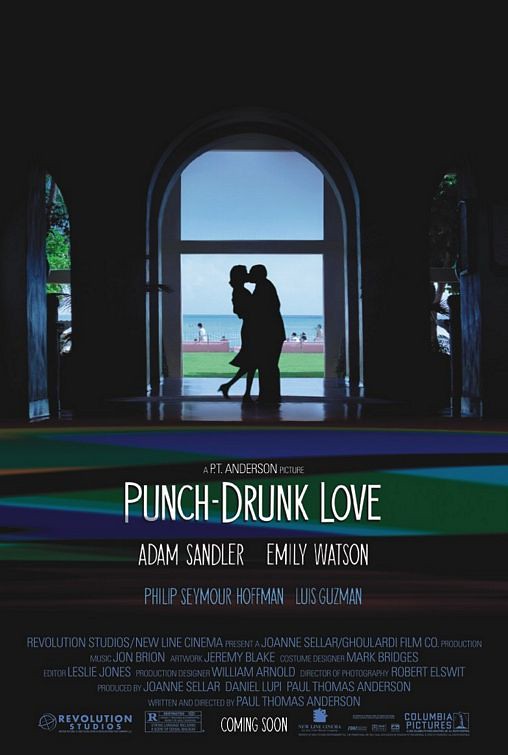
Punch-Drunk Love


It seems fairly well accepted, at least by my circle of friends, that There Will Be Blood is the work of a master, a Great Film, and an almost faultless piece of cinema. But I look at Punch-Drunk Love and I see the same strengths and control and complicated, beautiful emotional power on display here as there. In both films we have a very, very unlikeable hero who we love despite everything, who doesn't play well with others, who runs his own business (and has one trusted employee who overlooks his proclivities), who has a more-than-strained relationship with his family, and who is adversarial with self-serving religious men who exploit the dogma of their faiths. But where There Will Be Blood feels like a confident step into Wellesian or Kubrickian psychological drama... I was about to declare Punch-Drunk Love a response to all the quirky romcoms-for-hipster-dudes like Garden State or the films of Michel Gondry, but it turns out Punch-Drunk Love preceded them all by at least two years. So call it a zeitgeist film, the spirit of the times, the quirky romance turned on its head. Either way, the tone and scope here is quite different from Blood, but both are handled with the same even-handed mastery.

In my estimation, this is about a perfect film. It moves along so fast that you are never bored, and it's so tense with so many things under high pressure that you can't bear the wait for that pressure to release. Each time it finally does, it's both unexpected and fully rewarding. Each scene is a masterpiece of colliding subplots (the exact opposite of Up in the Air, with its compartmentalized storylines; also: today's theme has been men who collect frequent-flyer miles). It is told with the precision of films today that I have focused on so much of late, but with the kind of right-brained subjective reality and filmic poetry that I have been half-lamenting the lack of. For all of its careful camera moves, orchestrated (and subtle) performance cues and strictly structured timing, the story is more abstract than concrete, more irrational than straightforward. I love it.

We watch Barry Egan act like a shy monster, at turns awkward or terrified or violent, and even though he almost never says or does anything that is traditionally pleasant or charming -- he is never comfortable in his skin enough to be nice -- he is one of the most hypnotic and engaging and sympathetic characters in a long time, and that's because we are undeniably living inside Barry's head, hearing the musique concréte soundtrack that clutters his thoughts, whirlwinding through tiny events that feel huge and huge events that feel telescopically far away, right alongside him. Every single moment of joy in the story (a side note: it feels, roughly, like for every positive action in his life there is an equal and simultaneous negative action to correspond; this plays into the "colliding subplots" observation), we are thrilled and cheer him on. Or at least I am and do.

My two favorite romantic comedies of the modern era, if not all time, are undeniably Eternal Sunshine of the Spotless Mind and this jagged/polished, cool/tense, manic little gem. I could watch it over and over again. And will.

14 December 2010

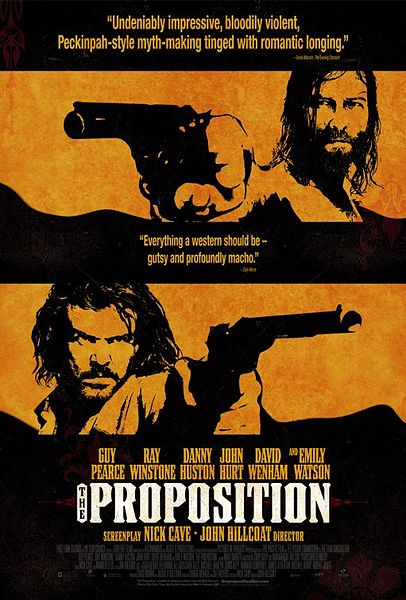
The Proposition


There's a point in the movie when Samuel asks Arthur what a misanthrope is. "Is that what we are?" he asks. "Good lord, no," says the brutal, savage, monstrous killer Arthur Burns. "We're a family." It's not terribly subtle, but there's a reason this story can get away with that kind of handholding; there's a reason we are made to see so plainly the contrast between the bandits with the poets' souls and the more cold-hearted citizenry (and especially Eden Fletcher and the British soldiers under Stanley's command). We get it, the civilizers are uncivilized and the rogues are the ones quoting poetry and admiring sunsets. It's not like that reverse-dichotomy hasn't been explored before, is it?

But Nick Cave and John Hillcoat are doing two things here that justify this (in addition to the usual stuff like gripping performances, stunning photography and tightly scripted action). One, they're showing us a world where savagery is beauty, and where violence is poetry -- and not just in a hyperbolic sense. It makes you really feel it, as if it's perfectly rational that a man's head being blown off, or a sudden spear through the chest, are elegant things to behold.

And then there's the end, the reminder that these poet's souls we've been admiring, the seductive legend of a man Arthur Burns and his creepy-charismatic follower Samuel and the rest, who admire nature and live as a family and only want to be left alone, truly are as savage and monstrous and evil as their reputations suggest. The casual, business-as-usual invasion of the Stanleys' Christmas dinner leaves no doubt in your mind who the bad guys are.

But they do make such wonderful, complicated villains. One of my favorite telling lines is Arthur's, when Charlie has a gun to his head. Arthur has just delivered a non-killing (or slowly killing) stab to poor, racist (and oddly-named) Jellon Lamb, and Charlie cocks his pistol at his brother's head. Without even turning, Arthur says in a weary voice, "Why can't you ever just stop me?" I think Arthur is the monster he is because Charlie is his conscience, and in fact Charlie spends the entire film in an almost Hamlet-like fit of indecision, unable to act even though he knows he eventually must. If Charlie can't stop Arthur, then Arthur simply must keep going, keep pushing, keep on being the monster he is. It's not exactly, I think, that he wants to be caught, or stopped, or punished; it's that he wants to find the threshold he cannot cross, or the line that Charlie (his conscience) can't let him step over. He finds it, eventually, in the end, I suppose, but by then so much damage is done, and who's to blame for all we've seen here? "You never should have left us, Charlie," Arthur tells him early on. "We're a family."

Many stories are only as good as their villains. The Proposition has countless strengths beyond just the one, but it doesn't hurt how fascinating a character Arthur Burns is.

13 December 2010

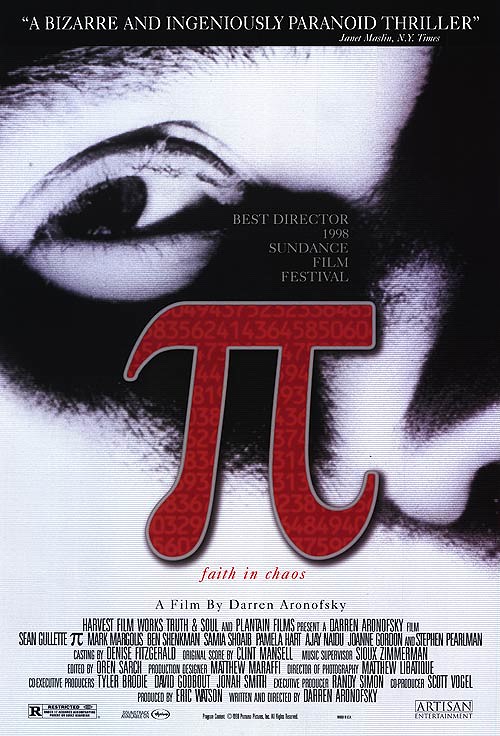
π (Pi)


Recently I was discussing the fact that three of the biggest films this year were by Darren Aronofsky, Christopher Nolan, and David Fincher (Black Swan, Inception, and The Social Network respectively), and that all three feel like excessively precise films -- like or hate the films, they're undeniably works by masters of their medium, with a tight, confident grip and control over every aspect of production, from the tiniest of details to the grandest of overarching themes. But their expert precision can be as much a burden as it is a strength. In the 70s people complained that the Hollywood New Wave was the first generation of filmmakers who'd graduated from film school, who'd studied nothing except the language of film, and that for all their intelligence and technical wizardry, their films were more about film than about life -- they were at one remove from the subjects. Well this is clearly the generation of filmmakers raised in the shadow of that previous generation; second-gen film students arguably twice removed. Following consciously in the footsteps of Spielberg, Scorsese, Kubrick, Welles, et al, there's a decided lack of looseness to their work. There is almost no improvisation, or randomness, or organic give-and-take. These are artists telling stories from the mind, not from the heart.

As much as I really liked The Social Network and Black Swan, and mostly liked Inception, they had a coldness to them. But so do the best works of P.T. Anderson, the Coens, Wes Anderson (!!), David O. Russell, Jim Jarmusch. It seems to be the trend, this bent toward precision and control. And for the record, I'm not against it. I just named some of my favorite big-name American filmmakers. But it does feel like a one-sided argument.

Pi (much easier to type than its greek-letter numerical title) is an argument for the other side. Imprecise, shot guerilla-style on grainy film, somewhat unhinged and never locking down what it's even about. It feels (now) like the bridge between Eraserhead and Primer. One foot deep into impressionistic psychodrama and one foot deep into the obsessiveness of science and math. It's also obviously a precursor for many or most the elements in Requiem for a Dream -- a film where Aronofsky tried out his hand at precise control before loosening up (a little) for the more abstract The Fountain. I wonder sometimes if the poor performance of The Fountain is what pushed him back in the other direction, toward the more linear and... cerebral is pointedly the wrong word here, but let's say controlled storytelling of The Wrestler and Black Swan.

Aronofsky's always been obsessed with obsession (which is maybe why being at one remove from his subjects comes so naturally), telling stories of characters losing themselves to their passions, or their weaknesses, or (often) simultaneously both. Pi is such an impressively audacious, confident first step, even if (partly because) it's a messy, overly abstract, slightly pedantic piece of madman poetry, a deceptively simple story told from a bent, subjective view that should be offputting but never is. Max Cohen is never unlikable, possibly because his weaknesses are so profound and prevalent, because for all his super-genius and arrogance he is pitifully human. It's a good touch, and there's a lesson in writing a strong protagonist here. He has specific objectives, specific obstacles, identifiable and (sort of) relatable weaknesses, and he's doing cool stuff that maybe we all (a generation of geeks and thinkers) daydream about doing. It's not a perfect film, but it's almost a perfect first film.

09 December 2010

El laberinto del fauno (Pan's Labyrinth)


After badmouthing this film so resolutely, I felt I had to return to it and give it a fair shake. After all, Pan's Labyrinth is the "spiritual sequel" to The Devil's Backbone, something Del Toro claims in the commentary track but something I (and I think most people) picked up immediately on first viewing of this.

For the most part I agree with my diatribe, that Del Toro is like (probably) every other fantasy or sci-fi director out there, and he is at his best when given a box he has to creatively think his way out of, rather than when he is given every tool in the chest and a limitless sandbox to build a world into. Pan's isn't as bad as I made it sound -- it's incredibly watchable, and exciting and fun and emotional -- but it's not really about much. What does our protagonist want? To escape the miserable world of reality. What stands in her way? Not nothing, exactly, but surprisingly little. The various complications of the adult world (here exemplified by fascists and rebels in 1944 Spain, though honestly couldn't this story work in almost any time, place, and circumstance?) and her own short-sighted hubris, I guess. Does she get what she wants? She does, by dying (an interesting choice, to be sure) and letting her soul wake up as a princess of the Underworld.

Meanwhile, there's the second story going on here, which actually I'm pretty sure gets more screen time: the drama of Captain Vidal and his troops versus the rebels in the woods and his treasonous house-staff. The problem here is they might as well be cartoon characters, they're all so two-dimensional and obvious. The parts are all well performed, but nobody's given much to work with. Vidal is a tyrant and a true clock-watching fascist through and through; the mother is a foolishly good-hearted woman too desperate to see the dangerous man right in front of her for what he really is; the maid and the doctor are your standard-issue double-agent freedom fighters, sneaking supplies from under Vidal's nose out to the rebels; and the rebels are a mostly faceless group of guerillas with sharp-shooters, wounded men and a loving brother among them, who somehow win in the end against all odds (in a major power switch we mostly pass over in favor of chasing Vidal and Ofelia through the hedge maze). None of these roles have much in the way of contradictions or unexpected quirks to their characters; none of them seem to offer much to the tapestry of the story.

Vidal's obsession with having an heir is his Achilles' heel in the war with the woodsmen (in his own words, his "pride" is his weakness), and his savage disinterest in Ofelia's mother's well-being actually aids Ofelia in her quest to escape reality by severing her singular meaningful tie with it. With Mom out of the way, there's almost no reason to mourn the child's passing -- which is to say, if her goal is "to escape reality and become a fairy princess" and she gets there without any real sacrifice, you end the film with the sense that not much was at stake for her. She didn't lose anything (that she hadn't already lost) in order to gain this new thing, and the victory feels cheaper for it. Further, she didn't even make the choice herself. Aside from protecting her infant brother from Vidal, the decision to "shed innocent blood" wasn't a conscious step on her part, and although the Underworld King and Queen claim she completed the final test by shedding her own blood rather than an innocent's, she didn't even put herself in front of the bullet; Vidal's (badassedly off-hand) murdering of Ofelia was a total shock to us and to her, and only happened by good fortune to satisfy the final quest to get the fairy princess back into fairyland.

I'll admit, I think analyzing the story this way is missing the point of the kind of fairy tale being told here. The thing is I can't help it. I watch a film and I read its story and look for meaning, and layers in that meaning. That's what I do. Pan's Labyrinth plays out like a uniquely dark (though perhaps a little too novel-for-its-own-sake) wish-fulfillment story. Little girl is born into a bad life, someone comes along and promises her something better, she perseveres in the face of various obstacles and is granted, in a twisted sort of way, her wildest desire. It's Cinderella. But a little more time spent on fleshing out the dimensions of the characters or tying the various stories together a little more would have gone a long way in taking a gorgeous piece of escapism and making it the masterpiece that Devil's Backbone was. This is more like its prettier, lesser shadow than it is a spiritual sequel, in my eyes. More polish, but less presence.

04 November 2010

Paths of Glory


Generally when a film is anti-war and anti-military it accidentally (or at least incidentally) becomes a film which is half war-porn, which is either too concerned with being "fair to both sides of the argument" or simply shows too much bravery and valor and so-called heroism. Either way, the result is often a film which too easily can be seen as pro-war by anyone hoping to see such a thing. But Paths of Glory is much less equivocal about it. This is a film that depicts authority as distanced, amoral and petty, and doesn't leave much wiggle room to see it as anything else. Generals are self-serving and interested only in the prestige of victory, in what it will do for their careers and reputations. The death of their subordinates is shown (in the least uncertain terms I've ever seen) as registering no more guilt or difficulty than the loss of supplies, or fuel, or time.

The drama of the story is strong, anchored by Kirk Douglas and a sharp script. To be honest, not every performer lived up to the material, but it's always easier to forgive that in a movie over fifty years old (it was a different era, etc., etc.) and anyway it's not nearly enough to drag down this film. Plus, the film is deceptively short! Maybe I'm just used to grander pieces by Kubrick, but I expected more from the first trial... and when I didn't get it I naturally assumed the greater story would be the second trial, of the general whose glory-seeking traitorous orders set the story in motion. But no, once Colonel Dax tells off the Major General the story has a quick and beautifully abstract (that is, tangential to the direct plot but resonating on a deeper level to what we've seen and what we know) closing scene, and it's done. In and out in under 90 minutes.

But there's something great about that. Because really, by that point it's said all it has to say. It didn't really wrap up all its threads in a cathartic-resolution way, but each story got enough that I'm not left wondering what next. It didn't overstay its welcome because the message is a little more poetic if it's left unspelled-out, the occasional loose end or raw nerve only making the sting a bit sharper.

And as a side note, just before watching this I'd asked a friend if he could think of any repeat performer in a Kubrick film besides Kirk Douglas. There must be other examples as well, but right here in Paths of Glory, as the outspoken, too-smart-to-be-a-soldier Private Arnaud, is Joe ("Joseph") Turkel, a.k.a. Lloyd the bartender from The Shining, also familiar to film nerds (like me) as Eldon Tyrell, the proto-Jobs/Gates-hybrid CEO/Father/God from Blade Runner -- so young!

03 November 2010

Psycho


I've already gone on at length about how cheap imitators of Psycho were so prevalent that they created a bad formula for an entire genre of film ("slasher" movies). And pretty much every critic ever seems to have belabored how awful the last ten minutes are, with Dr. Useless-Psychobabble-Exposition coming in and sullying an intelligent story's elegant conclusion. It's not enough to ruin the film, but that's only because the film is so good. Hitchcock consistently underestimated his audiences, I think, and this ending moment is one of the worst cases of it. (Another case is Spellbound: a beautiful drama, with dream sequences directed by Salvador Dalí, that hinges on a lot of overexplained, poorly understood gibberish posturing as psychoanalysis.)

What I haven't noticed really before this watching is that Psycho isn't a horror at all. It's barely even a thriller. It's pretty clearly a mystery film, if you ask me, and one that plays on three levels simultaneously without missing a beat. Check it out: there's dramatic irony because we know far more about what's going on than the various characters do (and I have a feeling Psycho can be read with Norman Bates as a late-appearing protagonist or with Everyone Else as a collective-protagonist and Norman as the antagonist; I'm inclined to see it as the latter). And then there's the twist, when we see "what really happened." In other words, there's level one, the story Lila and Sam and Arbogast and everyone assumes is true, that Norman (or, perhaps Arbogast? or maybe just Marion herself) ran off with the $40,000 and it's only a matter of putting together clues to get on the trail of the money, and Marion (alive or dead). But then there's level two, the story we assume to be true, that the money is meaningless and Norman is a (mostly) decent, sweet guy, who we can root for, who's just protecting a psychotic, murderous mother. But then there's level three, the reveal/twist (I'd say "spoiler," but come on... more people know the end of Psycho than know the end of Citizen Kane), in which Norman's mother has been dead for ten years, and in fact was murdered by Norman himself, and that Norman has taken to becoming his mother to sublimate the guilt of what he's done, thus lording over his own life the way he expects she would (or perhaps did). These three things aren't subplots, they're more like parallel explanations of what's happening: what they think is going on, what we think is going on, and what's actually going on. And all three are juggled masterfully. Up until the reveal, every single one seems reasonable, even the one we know is a wild goose chase for the world's most famous MacGuffin: Marion Crane's stolen money.

Once you know the end of course, there are plenty of clues throughout that this is what's happening. Never once does the movie "cheat" or have a moment that isn't satisfied by the final explanation. But even more than that, it's fun to watch some of the tiny gestures, to watch the evolution from Norman Bates, goofy shut-in (and by the way, I love the shit out of Anthony Perkins here... he may be my pick for greatest performance in a Hitchcock film, though it's a small list) to Norman Bates, sexually confused young man -- and of course it's the latter that triggers "Mother." When Marion comes in, all is well. When she says she's from Los Angeles, something about this triggers Norman, and he gives her the room closest to his office. Little moments like this, ways in which she makes herself available to him (gestures meant only as friendly, confusing and enticing to a reclusive man who longs to leave behind crazytown but knows he cannot) draw him to her. You get the distinct impression it's not a random crime, and that Norman doesn't kill every passerby (in fact we learn he's only killed twice before, both young ladies). This is a crime of passion spurned on by the feminine wiles of a nice young lady with a bit of the flirt in her and an obvious lie in her backstory. None of this is said, even in that unbearable info-dump denouement. It just is. It's all there to see, so (like everything else in the denouement) it doesn't need to be said at all.

The characters and the story are brilliant. The horror moments are strong, but I still say this is more of a murder mystery with a dose of thriller, and not really a horror at all. But considering how Hitch sold it to audiences, and the ripples it's created in today's horror movie... uh... pond (there's a metaphor that collapsed, ha!), it's not surprising it's thought of as a horror film. I guess that's not surprising, as a lot of the best films of any genre are the ones that come from elsewhere and bring with them a novel perspective and unique elements. The cinematic equivalent of genetic diversity, say.

02 October 2010

Per qualche dollaro in più (For a Few Dollars More)


Compared to the roughness around the edges of A Fistful of Dollars, this film feels much more the work of a skilled director working with a crack team. The photography is crisper, the performances feel more assured, the characters more fleshed out, and the story and dialogue (while a little hurky-jerky in terms of motivation) feels light years ahead to me. Fistful is a movie you can appreciate with a caveat. For A Few Dollars More pretty much doesn't need one.

My one criticism is, the story feels needlessly complicated at times, and is a little too willing to indulge in novelistic side-stories. It takes its time getting into the heart of the action, as well. But many moments stand out, and many images and scenes feel iconic, which makes the slow pace worthwhile. There's even some nice dramatic moments from Lee van Cleef and the actor playing El Indio.

It's been a long time since I've seen all of The Good, The Bad, and The Ugly, and obviously I'll be watching it again, soon, to complete the trilogy, but so far I might like this one best. The world feels the right kind of lived-in and historied, and there seems to be a good balance between darker and lighter moments. Again, if the pacing weren't quite so full of fits and starts, and maybe if they'd cut the movie by about twenty minutes runtime, I'd call it nearly a perfect spaghetti western. As it is, and based on memory, this might be my favorite of the Man With the No Name films.

25 September 2010

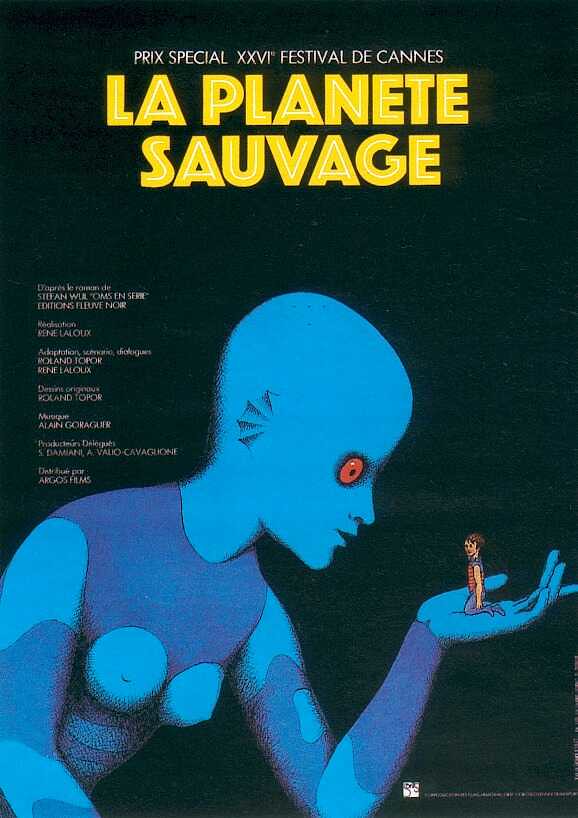
La Planète Sauvage (Fantastic Planet)


It's hard to think of a more surreal, alien approach to a story about aliens than this. It opens in media res on a silent, terrified human holding an infant and racing away from nightmarish, dangerous things (animals? plants? geometric oddities?) on an endless plain. She thinks she finds safety in the high ground, but a massive blue finger prods her roughly back down the hill. She races up again, looking to be safe, but the finger prods her once more. This continues, a sort of inverse Sisyphus, until the finger grows bored. It lifts the woman into the air, high high into the air, and drops her. She tumbles and dies. The baby is alone and scared. We pull back to reveal the hand belongs to a strange blue creature (a Traag) that looks like Dr. Manhattan bred with a humanoid fish. The story then shifts perspective to these massive, psychic mysterious creatures, and a child named Tiwa who adopts the baby. We watch for a while as she dresses it up in preposterous humiliating outfits, but the baby is a tiny pet, no bigger than a hamster. The baby doesn't know any other way of life.

Traag time moves slower than Om (homme, or human) time, which gives the story a really novel arc as Terr (the baby, whose name is apparently short for terrible but also evokes the word Terre, the French word for Earth) grows into a boy and eventually a man, while Tiwa and the other Traags don't age much at all. In typical future-dystopian fashion Terr escapes and lives among the wild Oms (living in the park!), and his unique skills (knowledge and education) first cause strife within the group but eventually turn the tides and help them win the war. Of course, things are much, much stranger than that when you watch it.

Apart from a surprisingly abrupt conclusion (and some cheating narration throughout which is mostly forgivable), Fantastic Planet is an inspired story. It belongs in the same camp as classic science fiction like Dune and Solaris. It's maybe the smarter, artsier cousin of Planet of the Apes or The Matrix. I'd actually have liked to see them go further with many aspects (I had this same reaction to another kindred spirit: TRON) but overall, I'm totally impressed.

I could go on about the animation style and the music -- both feel dated but perfectly suited to the piece -- but I feel I've run on long enough. Suffice to say it's a great film, maybe a genius one. If you've never seen Fantastic Planet but you like science fiction -- I mean real science fiction, not just robots and aliens being used as a delivery system for explosions and chase scenes -- I think you owe it to yourself to see this film.

17 September 2010

Per un pugno di dollari (A Fistful of Dollars)


It's interesting to note that in this, the film that made Clint Eastwood, the actor looks just a little too pretty-boy to be believed as the badass stranger he's meant to play. Because he went on to embody this archetype so absolutely over the next two decades, there's a kind of cognitive dissonance in watching him here. It's like watching a man in an ill-fitting suit, even though you've seen that man in the very same suit dozens of times and you know it's a perfect fit.

A cursory glance through Wikipedia tells me that this was Leone's first spaghetti western, and that it was early in the genre's life, which makes sense. Like Eastwood it feels like the genre and the director are both finding their footing here. It's a little rough around the edges, but it's definitely got something. I wonder how we'd view Fistful if it hadn't been followed by For a Few Dollars More and of course, The Good, The Bad, and the Ugly, among so many others. If Leone and Eastwood hadn't gone on to be the defining names of this type of storytelling. Taken on its own merits, it's a western remake of Yojimbo (itself an adaptation of Hammett's Red Harvest, such an awesome road from mobsters to samurais to the old west), and it's got a lot going for it but it's also clearly a b-movie in a b-movie genre; it doesn't quite transcend. It's impossible for me not to see this through the eyes of someone who's seen later, greater works in the genre, not to mention who's acutely familiar with the source materials that led us here. Trying to view it as a stand-alone piece, I think it's fine, but that's about it.

Also, this film influenced more than just the stylistic choices of Leone's later films and spaghetti westerns in general. Eastwood would later direct two films of his own, High Plains Drifter and Pale Rider, about a stranger who rides into a corrupt town, fights the forces that be with cold brutality and shifting allegiances, and then rides back out at the end. In fact, if memory serves, he remains nameless in both films and they're implied sequels to The Man With No Name. More to the point, though, I found both of them to be stronger films than A Fistful of Dollars, definitely the work of a man with a firm grip who'd found his voice and his style. But I guess it all started here.

11 July 2010

Pusher


At first I was hesitant to put this on, since I've been going through The Wire for a while now, and after such a complex view of the drug trade I was fearing a more simplistic, stylized perspective would come off cheap and flashy, but the Pusher trilogy has such a good reputation I figured it was worth the risk. In fact, it doesn't come off as a glossy version of the kind of story The Wire stretches out over fifteen hours at all. Where The Wire is a sort of Threepenny Opera view of how both sides of the system work the same and are flawed in the same ways, Pusher sticks to one man, and is a story about desperation and greed, and how slippery the slope is from being in control to being totally out of control of your own life.

Frank really didn't do anything to wrong his dealer and friend, except perhaps he was sloppy out of greed in setting up a meeting. When backed into a corner he took the only way out he saw: dump the drugs in the lake and surrender. In Pusher we get to see a lot of what you can (or can't) do when backed into a corner. Mostly it's Frank, over and over again, still in the corner, but one scene that sticks with me is when Frank and his dealer's muscle (also a friend; names escape me) go to collect a debt owed to Frank from a weaselly whimpering junkie. Having no money and no means, the muscle says, hey no problem, here's a shotgun and a plastic bag, go rob your bank and bring us the money. This hard-as-nails you-do-what-you-have-to-this-isn't-our-problem approach to money collecting is intense: your choices are, cross another line or lose a kneecap. Backed into the corner, the junkie tries another approach: he turns the gun on the muscle threateningly. But this guy lacks the nerve, clearly, and the muscle pounces on him, beats him. He points out, even if he'd pulled the trigger, Frank would have shot him, and nobody would win, so buck up and go rob the bank, bring us our money. Frank isn't happy with how this is going down, how hard the junkie is being pushed (eh? eh?) by the muscle, but it's him or Frank, so he keeps his mouth shut. The junkie has no other options. Only, the junkie finds one: two barrels in the mouth and painting the walls with his brains. The message here is clear: you think you're desperate now? We can push you even further. What's your limit? We will find it. Where the "we" in question can be drugs, power, authority, or good old-fashioned fate.

The end, then, is beautiful, as Frank's options are reduced for the umpteenth time to zero, he's pissed off his dealer friends, beaten his cohort senseless, and betrayed his downtrodden semi-girlfriend for the last time. She takes his stash, his lifeline to getting his name and security back, and disappears into the night. There is nothing to do, nowhere to go, no money to do it with, and nobody to help. Through a painful chain reaction of events starting from one simple choice, Frank has been thoroughly undone. He's a reactive protagonist for the most part (the end is preempted by him making one choice: he can either get out now or go back in for more, and his choice to walk away from his girlfriend and climb back into the ring is what leads to his drifting helplessness when she steals his cash and disappears) -- but that's the world Pusher sets up, and it never feels cheaply done. He's doing his best to stay out in front of the chaos and disaster, but like the police chase at the beginning, he's out of shape and he can only run for so long.

03 July 2010

おとし穴 (Otoshiana / Pitfall)


It's funny that the first time I saw this the doppelgänger element stuck with me so well but I'd forgotten entirely about the ghost-story element. In fact the Criterion essays describe this more than once as an "anti-ghost story."

Man, Hiroshi Teshigahara's trilogy of Criterion-released films -- this, Woman in the Dunes and The Face of Another -- are films I'm always trying to convince others to watch. Seems like nobody knows about this guy. Japan had their own Kafka (Kobo Abe), and that guy wrote some films, and those scripts were directed by a master of low-key surrealist-drama! Of course they're amazing, and of course I love them.

It's great how our hero seems at first obsessed with justice for his murder -- and how the other ghosts wave this off coolly, saying everybody thinks like that at first, and warning that the more he learns the more troubled he'll be -- but in the end all any of the ghosts want is some kind of explanation for the cruelty and suddenness of their own demise. But there are no answers for them, no concrete ones; life is what it is, and forces bigger than you and tangential to your life will one day brush up against you and snuff you out, and there won't be any reason for it that you'll ever understand. Plus, as the other ghosts point out, once you're dead what does it even matter what the reasons were, or if the living discover some kind of truth about you? My friends, this is textbook absurdism right here, and I love every existentially cynical moment of it. Admittedly, that's not everybody's flavor, but for those it is, it's a wonder they haven't seen these films.

There is also the wonderful recurring theme of doubles here, binary pairings throughout. Ghosts to their bodies, the man and his double, the two unions at war, the man and his son. Almost everybody in this movie is partnered up so we can chart a continuum between poles. The three notable exceptions I can think of are the boy at the end, cut loose from his father (and his father's double: how confusing that must be, plus then to witness four murders!); the woman for much of the story, and look how psychically adrift she was for being without the "friend" she expected to write her a letter and save her from purgatory; and of course the man with the white gloves, the agent of chaos, the true killer and schemer. I could postulate all day about what or who exactly the man in all white represents, but the very point of the whole thing is -- all mysteries and wonder aside -- I can never know.

12 April 2010

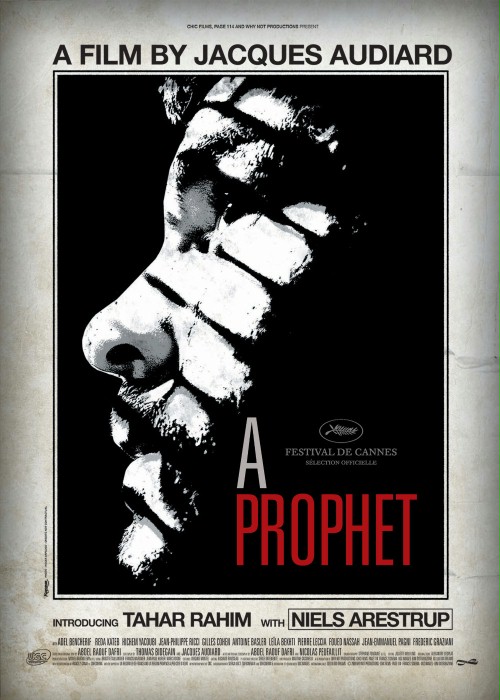
Un prophète (A Prophet) *


When did all the best crime movies start coming out of Europe? It seems like a genre built for America, with its history of noir and gangsters, but our output has been pretty watered down lately, seems like. The Departed is an okay Hollywood drama, but doesn't have the kick of Goodfellas or The Godfather. Collateral was good, but Public Enemies wasn't. Seems like we're caught up in overexamining character here, letting go of classic rise-and-fall or dethroning-a-king style stories like Gomorrah (still to be watched) and A Prophet. Here characterization happens incidentally, and often obscurely. To quote Ebert, "Many movies and actors are too ready to inform us what everyone is thinking, and why. It's more absorbing for us to read significance from mystery. An actor who reveals nothing, like Alain Delon in Melville's Le Samourai, is fascinating."

What stuck with me most from this was the constant use of visual metaphor to deepen an already rich story. From images on César's television to planes flying overhead to the (English) lyrics of soundtrack songs, everything was a way of expressing different layers of what the characters were thinking, or where they were in their journeys. A Prophet is one part The Godfather, one part Hammett's Red Harvest (see: Yojimbo, A Fistful of Dollars, Miller's Crossing, Last Man Standing), one part treatise on Arabs in France, and a dash of call for prison system reform. But it's also an exciting story that doesn't pull its punches. It's mean and exciting and layered.

Seen at the Fox Tower.

10 April 2010

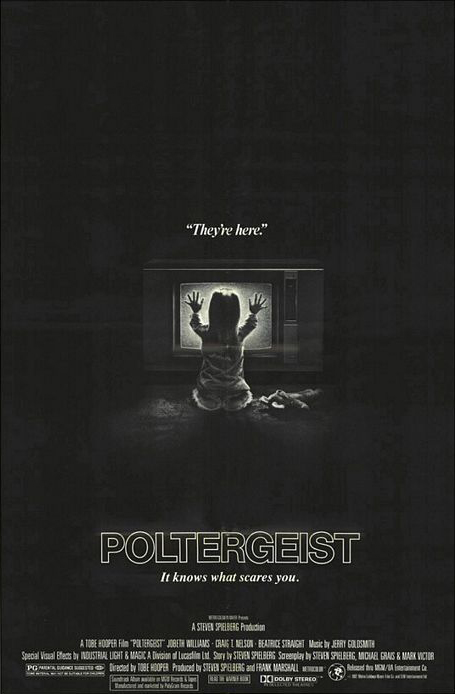
Poltergeist


It's Steven Spielberg's companion piece to E.T. (which I plan to watch soon as well), but it plays out a lot like Jaws. I can't help but point out, the special effects here remind me more than anything of Ghostbusters (which came two years later), and the funnest parts are the parts with the least prosthetics, when it's just flashing lights, intrusive soundtrack, and dramatic acting. Though the big monster things and the Cronenberg-lite doorway stuff all look pretty good, too.

The Spielberg flavor of monster movie tends to involve a slow build followed by a big confrontation followed by a bigger, almost outlandish confrontation, followed by a quick (and in this case, charming) denouement. (I know it's a Tobe Hooper film, but it's really a Spielberg one.) Actually, it's interesting because the characters don't feel one-dimensional or anything, but they do lack the usual flaws and personal weaknesses that drive most narrative. Here they are loving, patient parents; they aren't too busy, they aren't selfish, they aren't negligent or short-tempered. Steven even balks when he has to say the words "I'll spank you" to his daughter. These are the nicest people in the world who just happened to get the shittiest deal in real estate history. Steven was complicit in the crimes that made the story happen, but unknowingly, and is clearly remorseful for his part and reproachful toward his boss about the whole thing. So here we have a story of a largely flawless, morally problem-free family against a mean-old demon and a haunted house. (When I put it like that, you'd think Clint Eastwood directed it.) It's just not a story about the people, I guess.

These posts have gotten even more unfocused than ever. I'll see what I can do about that.

08 March 2010

Paris, Texas


This is a film I've been promising myself I'd watch for about four or five years now. But before I got around to it, the Criterion version came out, so I put it off until I could get a copy. And then the Criterion Blu-Ray came out, so I put it off some more. Now I've finally seen it.

It's just like everybody said. A rich tapestry of a film, a layered story with a lot to absorb, and I'm still letting it sink in. It's such a complex narrative about family, family roles, expectations, guilt, and (it wouldn't be Sam Shepard without) being haunted by the sins of one's past transgressions. They say it's about America. I can see that. About being rootless. I can see that too.

I think it's about fear, and facing one's demons, and it's a decidedly brooding, unmelodramatic (though maybe sentimental, in a not-so-bad way) approach to facing one's demons. That is to say, it's soft-spoken and uncathartic. I think it's about the roles we play in each other's lives, especially in a family. Hunter's got two dads, a mom and a half, but rather than fighting over him they're all willing to give him up -- out of love, because they all have a different idea of what'd be best for him. In the end, he's with his quasi-stripper mother, and you are left wondering if this is for the best. But bear in mind the moral turnaround the last reel of the film gives you with Travis (what a great name for a character, by the way... really genius), learning that our sad, broken hero is in fact such a monstrous abuser his story sounds absurd, unreal, made up -- considering the man Travis is, maybe Jane's not so bad after all. The irony here is that it seems clear that Hunter should have stayed with Walt and Anne in their rich suburban L.A. house, their public school system and their stable, decent lifestyle. But the bonds of family... well, that's got a gravity all its own.

20 February 2010

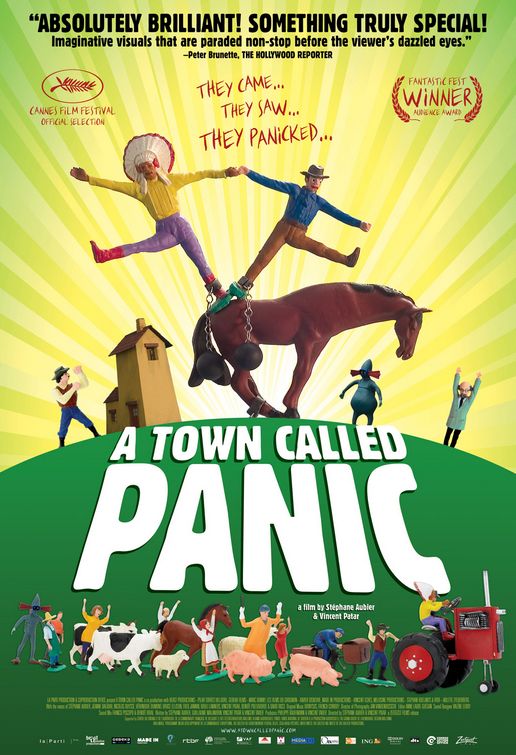
Panique au village (A Town Called Panic) *


What a manic film! Despite being nonstop fast-paced (like, short-attention-span paced) action, both Megan and I were kind of antsy through parts of it, waiting for something to happen. The reason is, there's no throughline or main plot tying together all the wacky adventures. Well, sort of there is, but it's so late in the game that the many competing subplots in the first two-thirds feel overwhelming, bordering on white noise.

Still, Panic is inventive and very funny at parts, and it smartly plays to the strengths of its limitations rather than letting them hold it back. The tiny plastic figures and their erratic stop-motion movement are consistently surprising and the storytelling is witty, if slapdash. It makes sense that this was a series of five-minute episodes first. I was going to add that the story style and the humor (though not the animation technique or look of it) remind me of Nick Park (Wallace & Gromit) stuff, and then I see that Aardman Animations distributed the original series. So there you go.

And boy, those Belgians love their waffles... apparently.

Seen at the Broadway Multiplex as part of the Portland International Film Festival.

14 February 2010

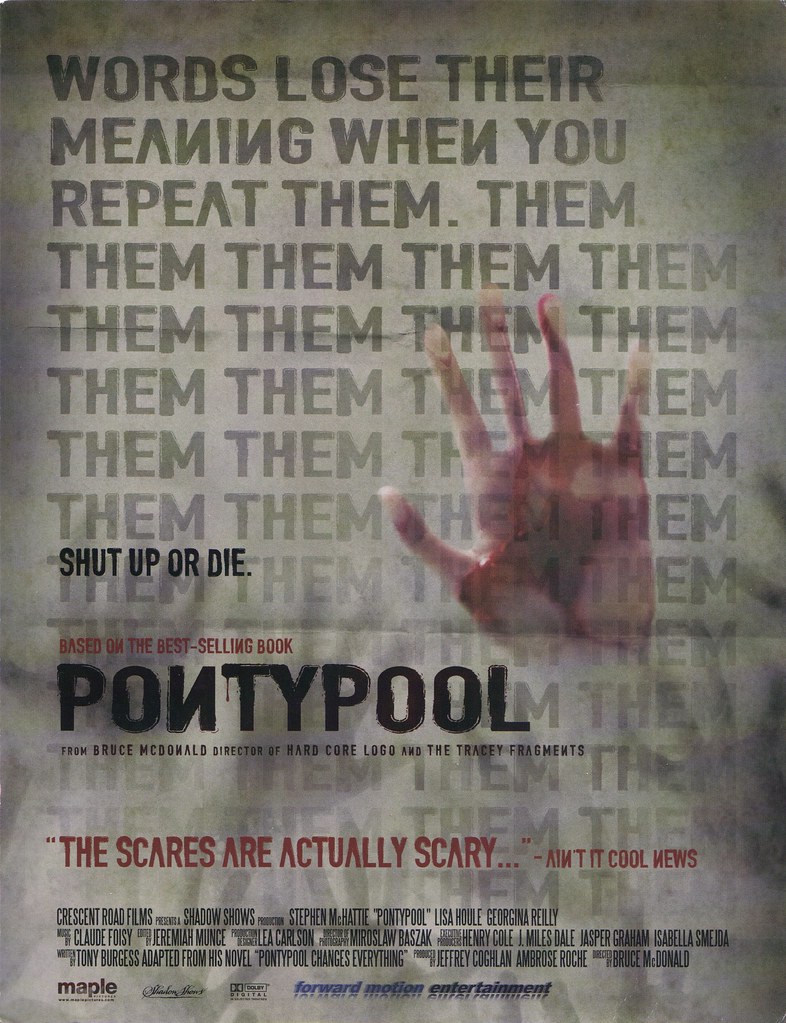
Pontypool


There's that moment in horror films, especially in zombie films, where you have to get from "What's happening?" to "This is what's happening and what now?" It's the info-dump scene, the exposition, the reveal, the As You Know, Bob. Anyway, that moment in Pontypool feels a little bit weak, kind of glossed over.

But the rest of it, right up my alley. For the most part it's legitimately creepy and scary, and the acting is solid (Stephen McHattie is amazing, and that voice: perfect!) and the story mostly works. It's scarier being trapped in the booth with our heroes than it would be running around in fields wielding torches and chainsaws. I'm a big fan of word-salad, dadaism, cut-up technique, all that stuff, but I also have an overdeveloped respect for the power of words that maybe borders on fear... so word-salad zombies really works for me.

I have to admit, though: I don't know how to interpret the end. I think I'll go read some online stuff and see if I'm the only one who was left a little confounded.

12 February 2010

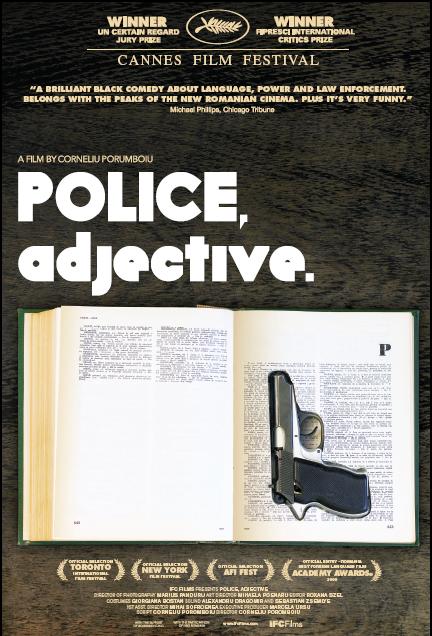
Poliţist, Adjectiv (Police, Adjective) *


The police procedural is such a commonplace genre these days, but this... this took "procedural" so literally that the result borders on surreal. Its painstaking attention not just to detail but to the very notion of detail makes what might have been a simple story into something absurd, and ultimately absurdist. The degree of effort one man puts into such a small case and the weight of a system pressuring him to just arrest someone and move on is balanced by every character's obsessive attention to the minutiae before them. Entire setpieces are devoted not just to debating the meaning but also the intent of the meaning behind pop lyrics or dictionary definitions. The main obstacles in Cristi's path are petulance and indifference, but they are enough. And ultimately, his best-case-scenario end-game will have almost no impact whatsoever: it will just appease our hero's conscience about which of two kids gets sentenced to three-to-seven years for a petty offense he doesn't even believe is wrong. And yet, it feels very much about a real person, a human character. Like I said: absurdism.

But what really wowed me was the economy of the filmmaking. For a film with so many long, slow takes of people standing, or walking, or watching nothing happen, no opportunity is missed. It all looks banal and mundane, but every frame is filled with visual metaphor. Every meaningless conversation resonates thematically. A speech midway through challenges you to ask what the banality means, and what the writers mean by what it means. And so: wry observation of very human moments, self-referential critique, circular logic and low-key absurdism? Of course I liked it.

Seen at the Whitsell Auditorium as part of the Portland International Film Festival.

(On a side note, if I may vent: the Whitsell is easily the least comfortable film-screening venue in the entire city and I will unfortunately be seeing a good number of films there in the next two weeks. I turned down a chance to see The Girl With The Dragon Tattoo tonight partially because of the line but mostly because another two hours in those cramped seats craning my head around others to keep up with subtitles sounded absolutely miserable. It's such a shame the Art Museum and the NW Film Center are stuck with such a poor theater, but what are you gonna do. You want to see these films, they got you by the balls.)