Showing posts with label john huston. Show all posts

04 March 2011

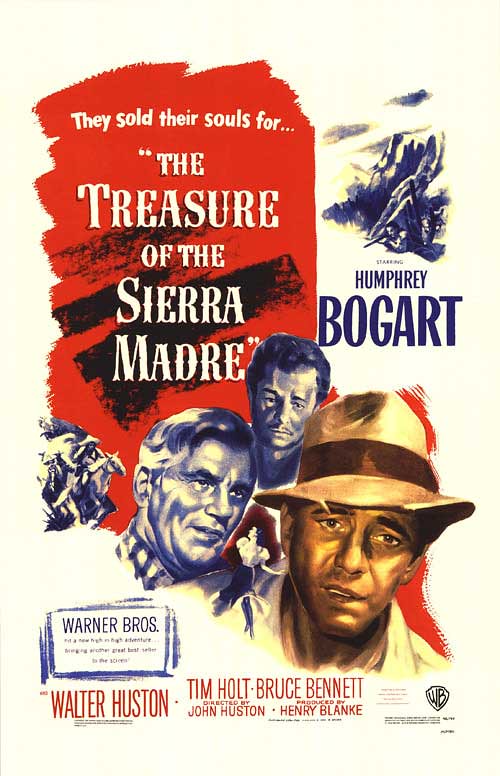
The Treasure of the Sierra Madre


I just mentioned this recently, actually, but one of many unrealized projects I have floating around waiting for me to get back to is a crime/road-movie about a trio of people with a too-good-to-be-true shot at millions of dollars if they just do one quick criminal act and then drive quietly down to the Mexican border. Katalin Varga has vague overtones of that kind of a story in its DNA, I admit, but almost no story is as big an influence on this idea as The Treasure of the Sierra Madre. The idea of well-intentioned desperate people, facing the challenges of character most people don't have to actually face, and learning what kind of a human you really are, has no greater forebear I know than this (though I have always wanted to see Erich von Stroheim's Greed).

Casting Bogart in what might be one of my favorite Bogart roles, a sort-of-against-type/sort-of-perfectly-to-type ruffian who slips a little too comfortably into the role of paranoid murderer as the story goes -- even his fairly brutal (though off-screen) death -- I always wonder if there's a bit of stunt casting in that. I mean, he'd been a box-office star for seven or eight years at that point, had already done Casablanca, The Maltese Falcon, The Big Sleep and so on. Here he starts out down on his luck (even begging from an eerily dapper-looking John Huston cameo) but charming enough, and there's no reason going in to assume that this is going to end with him a raving, dirty, bearded lunatic, a killer and a thief, hacked to death by bandits while trying to flee like a coward. It's perverse, and it gives a little extra oomph to the idea that greed can turn even the best of men into monsters.

The whole cast is brilliant. The story is unexpected and beautifully told. It's also unblinkingly intense without feeling unusual for its time or place -- that's a hard concept to articulate right now (it's pretty late as I write this, to be honest), but it's something John Huston has always seemed a little better at than most of his contemporaries.

I have seen the first half of this movie a dozen times now, and the second half about twice. That's not a judgment on the film but on the bad timing of when, over the years, I've chosen to put it on. It's a weird kind of brutal-comfort film for me, somehow, possibly because of my own story that was borne spiritually out of combining elements from this and Bring Me The Head of Alfredo Garcia. But regardless, there's very little negative to say here; I love this movie. One of my favorite classic films.

05 February 2011

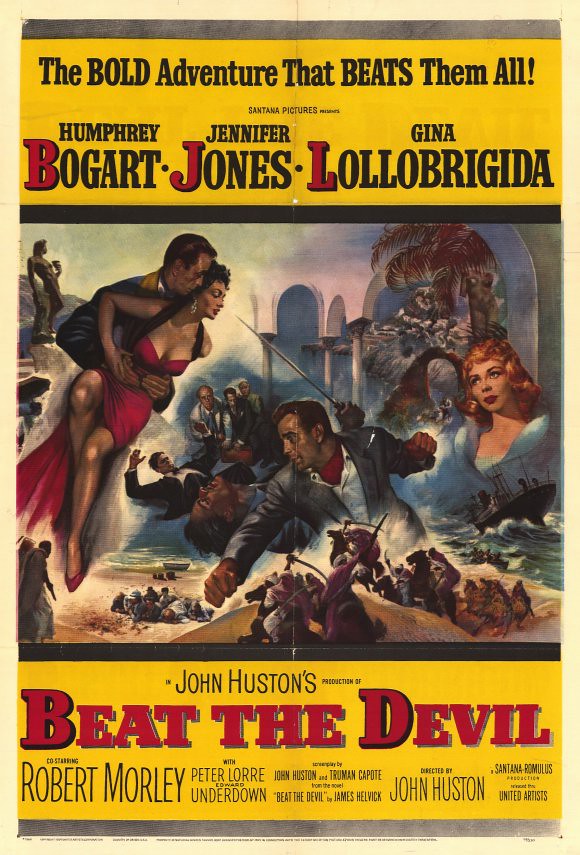
Beat the Devil


Sometimes I do myself a favor by remembering that I very much want to see a film and allowing myself to forget the reasons why. It gives me the impetus to pay attention and adds the fun of trying to figure out what piece of long lost lore or trivia led me here in the first place. I remembered that Beat the Devil was a less popular (non-blockbuster) Huston film with Bogart, and that at one point I was very excited to watch it, but by the time I sat down to do so I'd forgotten why, and watched it with a blank slate.

Immediately it was obvious that Bogart was playing a kind of posh John Huston. Aged as he was, with his skin starting to sag and his teeth looking more and more like old-man teeth, he even looked like Huston. The mannerisms were good too -- a little affected, a little entitled, but also gruff and no-bullshit.

Billy Dannreuther (it sounds distractingly like everybody calls him "Dan Rather," and Humphrey is no Billy) is cynical and manipulative and knows when to put survival before dignity. He plays everyone against each other and like his Spade or Marlowe he tries to stay out in front of the various conniving bad guys so he can score the loot and get the girl. I found it impossible to watch this movie and not keep comparing it to The Maltese Falcon, right down to the appearance of an always-fun Peter Lorre and a languidly verbose, sweaty fat man who seems sometimes like the leader of the ragtag gang of ambitious crooks -- it isn't Sydney Greenstreet, but Robert Morley plays it with the same kind of fondness for his own blather. The main difference, though, is that here everything seems to go wrong, and often comically. The car going down the hill and off the cliff; the boat sinking; Billy fleeing the Arabs, getting caught, weaseling his way out of danger by throwing his companion under the bus in his place. It was almost like Huston was turning his own film on its head and shaking out all the hard-edged bravado, leaving only the nonsense and schemes and shifting loyalties and ever-changing backstories.

And so, when I finished the film I peeked online to see if I could figure out what had drawn me here in the first place. Sure enough, plain as day, Wikipedia says, "It was intended by Huston as a tongue-in-cheek spoof of his earlier masterpiece, The Maltese Falcon, and of films of its genre." Written (apparently on the fly, day to day) by Huston and Truman Capote, it was the director taking the piss out of a genre he helped make huge. It apparently tanked and Bogart disowned it to some degree ("Only phonies like it") and Wikipedia goes on to call it "the first camp movie," but I admire it beyond all of that. It has undeniably fun characters, and isn't boring for a moment. (The romance is just as rushed as its forebear, but there's vastly more chemistry between Bogart and Jennifer Jones than he ever had with Mary Astor.) The plot is insane, leaping (fairly seamlessly) from manic slapstick to shifty-eyed noir to weapy romance to high-stakes thriller, and it never slacks in any of these.

Beat the Devil comes off clearly as the work of an old-hat at genre film who's bold enough to challenge the expectations of an audience, but it's also got the punk attitude of a great director rewriting old formulas. If artists didn't so willfully color outside the boxes every now and then, we'd never move forward artistically. In that sense, it's easy to see this film as a predecessor to anything from Romancing the Stone to The Big Lebowski to Shaun of the Dead. Anything with a gleefully deconstructionist bent, really.

Personally, while I can see why it wasn't a huge success and isn't as fondly remembered as The Maltese Falcon or The Treasure of the Sierra Madre or The Asphalt Jungle, I still really enjoyed this and am very glad to have seen it. It feels in its way like an important film, because it's bold enough to spit in the face of something both I and the filmmakers clearly hold dear. Dismantling a thing you love is a hard thing to do but it's so rewarding when it's done well. And here it's done well.

22 January 2011

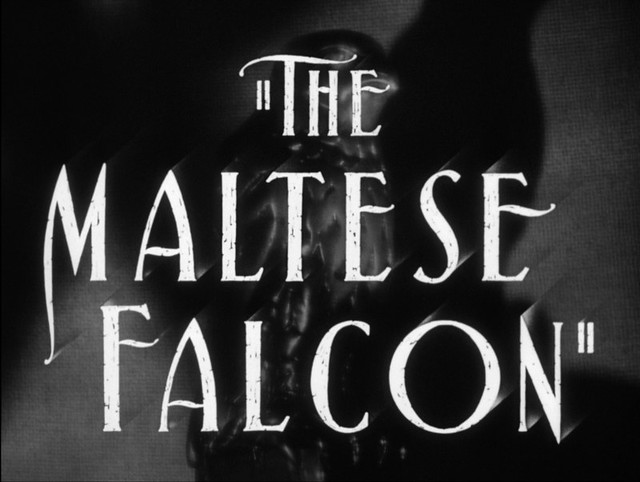
The Maltese Falcon


It's really hard for me not to compare The Maltese Falcon and The Big Sleep. They're two of the most famous detective novels from the golden age of detective novels -- the former by Dashiell Hammett and the latter by Raymond Chandler. (Much has been written comparing these two, though if memory serves they both loved and respected each other immensely: Hammett wrote sharp action in the third person; Chandler wrote quippy dialogue with a first-person narration... beyond that I forget the details of the debate.) They're both also classic detective movies, obviously both starring Humphrey Bogart, directed by two of the greatest (and both somewhat notorious, right?) filmmakers from the golden age of Hollywood filmmaking: Falcon by John Huston and Sleep by Howard Hawks. And they both take really different approaches to the mystery formula.

In each, the hero (Sam Spade here, Philip Marlow in Sleep) is a tough-as-nails, quick-witted detective who improvises boldly as a way of staying one step ahead of the chaos long enough to put together all the pieces of the puzzle. But where Marlowe comes off as fearless and sarcastic, Sam Spade actually comes off a bit like an asshole. It's hard to imagine Marlowe sleeping around with his partner's wife, both of whom he seems to practically loathe, or feeling so apathetic about a friend's death that the only reason he avenges it is because letting people kill detectives isn't good for business. But the hero's relative morality isn't the difference that stands out to me. What stands out to me is the story, and how linear and rational Huston wants to be, and how loose and abstract Hawk is willing to be.

The Maltese Falcon is at every turn concerned with keeping all the details straight as it goes through its labyrinth of twists and turns. The players are all full of useful exposition and the majority of the story is listening to each character lie or change sides back and forth, as everyone vies for the titular macguffin. In The Big Sleep, the details are so fuzzy that even Hawks, Bogart (and Chandler himself, reportedly) weren't sure why each murder took place or who was ultimately responsible. For sheer story and colorful crooks, The Maltese Falcon seems to win out, because each beat in the story makes rational sense and because Greenstreet, Lorre, and Cook are wonderful character actors used brilliantly. For mood and dialogue, though, The Big Sleep weighs out better.

But the final deciding factor for me between these two is the romantic chemistry and the performance of the story's femme fatale. Falcon comes up pretty weak, if you ask me, and although Mary Astor doesn't do the film any favors (she and Bogart are supposed to fall almost instantly in love, but they have no chemistry), it should be pointed out that her character is written pretty sloppily. Still, it's possible a great actress could sell us on the untrustworthy, self-serving backstabber who becomes a damsel-in-distress at the drop of a hat (and a lot of proverbial hats get dropped throughout), but Astor never manages to tie all the lies and pleas and plasticity into a single, satisfying character. On the other hand, The Big Sleep pits Bogart against Lauren friggin' Bacall, who holds her own against Bogey's sardonic wit and always reads as a character with depth and personality and feeling. So, it's not fair.

I still like The Maltese Falcon a lot. Seriously, any time Bogart, Greenstreet, Lorre or Cook have scenes together it's classic stuff; and it's fun to watch Sam Spade make shit up to everyone he talks to and struggle to outpace all the conniving and backstabbing (it's easy to see how George Lucas and Steven Spielberg drew a straight line from the kinds of characters Humphrey Bogart played into the kinds of characters Harrison Ford would play thirty years later, with Han Solo and Indiana Jones both acting very much as Bogart does here). But even though its story makes so much more linear sense than The Big Sleep, there's really no question which of the two I hold more fondness for.

19 November 2010

Under the Volcano


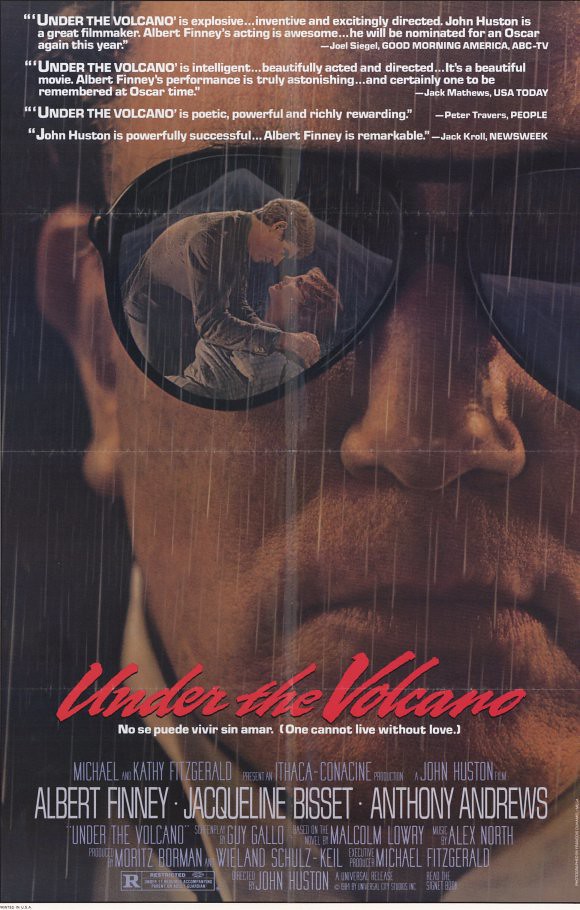
This film feels like it's purely about the charisma of staring into the abyss, the magnetism of a downward spiral. Specifically, this film charts a varied and colorful spectrum of alcoholism through a single man so far gone that he -- to paraphrase his own summation -- must drink the right amount to strike a balance between the shakes and oblivion. The way his loved ones, his estranged/returned wife and his half-brother, tolerate his behavior speaks of a different era and philosophy, but it also speaks of a hard-earned understanding, painful though it might be, of what is left of Geoffrey Firmin and how this man survives. His emotional and psychic states are just as stormy and delicately poised as his physical, and the question in Under The Volcano is never "Will he live or die?" but "How long will he last, and what specific indignity will be his undoing?" After all, it's the Day of the Dead, and Geoffrey has been drinking himself to death for a long time now. Now's as good a time as any to let go.

Supposedly the novel -- apparently called one of the best novels of the 20th century, though to be honest I scarcely know of it outside the context of this film -- is full of colorful descriptions of drink-induced hallucinations and surreality, but the film is decidedly literal, grounded, and lacking in flights of fancy. I read a review somewhere that suggested Huston left all the hallucinations inside Geoffrey's head, and allowed Albert Finney to portray them as such. I don't know about all that, but the quality and quantity of madness behind those dark shades and half-confounded fish-face lips is legion. Under the Volcano threatens to collapse under its own weight, but at the same time it is amazing to watch, to take in, to let all that bleak energy wash over you.

01 April 2010

The African Queen


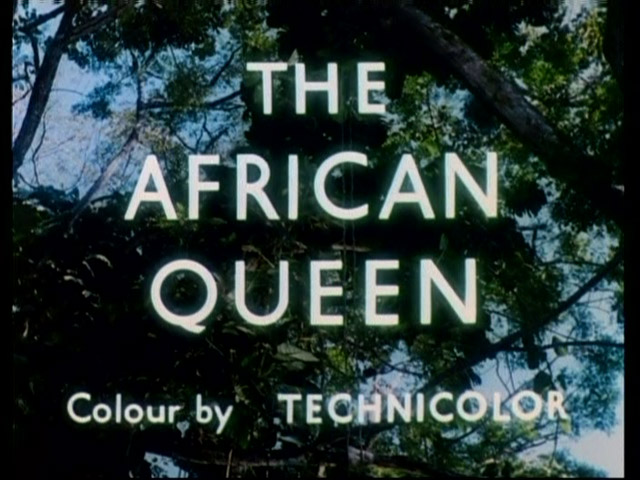
I think this might be a movie whose reputation preceded it a little too well. Bogart's only Oscar, National Registry, color film shot on location (with clunky Technicolor cameras! in Africa! in 1951!) by the great John Huston, famous romance between Bogey and Hepburn, famously rough shooting conditions, not to mention the movie's longstanding unavailability on DVD (it recently came out both on DVD and BRD, which is how I saw it) -- I think it all added up to more hype than the poor movie could live up to. It definitely wasn't bad, at all, but I don't think this would make my list of Top Ten Bogart films. The decision to act is far too hasty, the descent into love too smooth and bump-free (c.f. the rocky romance between the gruff sailor and the prissy journalist in Lifeboat... very rare I give points to Hitchcock over Huston for characterization!). Plus, the stakes seemed inverted. The river, the leeches, the gin, the rapids, the engine, the rain: these all seemed legitimate and threatening, but they were tangents, side quests, nuisances along the path to victory. The actual confrontations with the Germans, both at Shona and against the Louisa, these feel too calculated, too easy, honestly a little bit ridiculous. And I've already said, there really was no hesitation on the parts of Rosie and Charlie, no regret or missteps. Once they kissed awkwardly they were as good as married -- in that 1951 movie way where "married" equals "completely frictionless and essentially one soul with two bodies and a lot of pet names."

Huston made the world real, though, and Bogart did his damnedest-best to inhabit a very complex but un-Bogart character, which is always a pleasure to watch. Seeing him play dumb, gassy, and meek is kind of fun, and they really made use of his awkward teeth and slightly goofball grin. Still, Treasure of the Sierra Madre has Bogart playing the other end of the spectrum of un-Bogart-esque, wherein he is cruel, charmless, and creepy, and that's also John Huston and that I believed more than this. Maybe because it lacked the hamstrung romance. Huston seems better at manly adventures and urban male psyche stories than he does at believable love stories. Or at least the stuff I've seen. Anyway, I've rambled, and criticized a classic harshly, but it was good and I'm glad I've seen it. It just got stuck in the massive shadow of its own legend, and frankly I've seen all these players do better, is all.