Showing posts with label o. Show all posts

29 November 2010

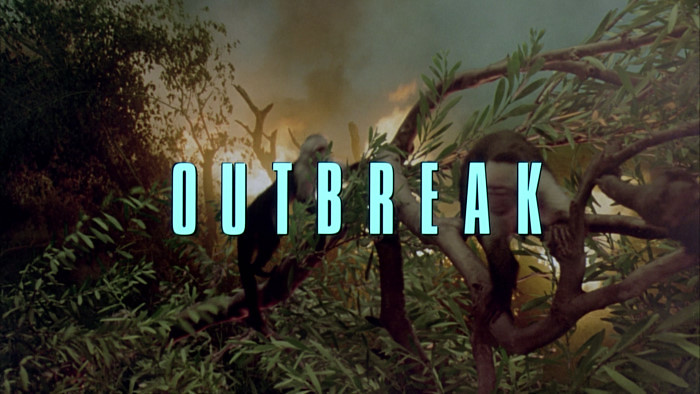
Outbreak


When this movie sticks to its procedural guns -- that is, when it tells the story of a super-infectious outbreak and the efforts by the military and the CDC to contain it -- it is in strong territory. When it heightens tension with romantic entanglements and infected loved ones, or evil generals hellbent on capturing and killing our hero to save their own necks, it kind of loses traction. (It's also, to be honest, built up on an awful lot of ugly coincidences and moronic slips in protocol: smuggling a monkey out of a cargo depot I can handle, but the nurse who sticks his hand in the centrifuge was a bit much.) Structurally, it falls right in line with a Roland Emmerich film: fake-out opening, meet the hot-headed genius nobody believes in, give him some data nobody will believe when he shouts about it, give him some deadlines and obstacles -- usually petty-minded antagonists and various loved ones in peril -- and start the clock running. And like Emmerich, it shortchanges some of the relationships and has a lot of needlessly clunky dialogue, but it moves along at a good clip by keeping the goals small and sequential, with heightened stakes and smart right-angle turns in all the right spots.

I don't have much to say. It makes me realize the kind of military approach exhibited in both versions of The Crazies is exaggerated and unreal, and I'd be better off toning it down if I can. That is, if I keep pushing on. (It's a weird thing, but watching Skyline earlier today kind of derailed me a bit. To stretch that metaphor, I have to decide if I get back on these tracks or drag myself over to some better ones now.) The military response in Outbreak (disregarding Donald Sutherland's turn as a ridiculously monomaniacal villain) is pretty reasonable and balanced. It's interesting to note that this was pre-9/11, but I actually imagine a response more like this one still being reasonable (possibly with more panic from the public and a lot more media scaremongering) over the round-em-up/fuck-it-kill-everyone approach from The Crazies. To be fair, though, Romero's a satirist, not a realist. So it's hardly a criticism to say Wolfgang Petersen is more of a realist.

09 October 2010

One Too Many Mornings


A personal note: director and co-writer Michael Mohan sent (or had his e-signature at the bottom of) my first congratulatory You're-A-Finalist email from the Sundance Institute, as well as the rejection email which inevitably followed. Plus, he's a friend of my good friend Dave. Although I've never met the man or corresponded with him personally, I feel a weird sort of... not kinship, but acquaintance with him. He's also just made his first incredibly indie, self-distributed feature debut, and everything about this feels like the kind of thing I could do if I really devoted myself to it. So it's inspirational and it's the project of a friend-once-removed; my point is, I went in really wanting One Too Many Mornings to be great, and really worried about if I'd like it or not.

I did like it. I liked it a lot.

It's got a great raw first-film energy. It's sleek and economical and never wastes your time, and the characters have a lived-in rhythm, a way of talking to each other that feels realistic, if not always real. The two main characters never bore me, even when they frustrate me to no end, and their relationship evolves organically. The shots are good looking and the editing and structure is tight. This is a good model for a successful first film. In fact, I have some filmmaker friends I'm going to have to show this to for that very reason. It's not flawless -- some scenes and a couple of the actors and actresses aren't quite convincing -- but it's never enough to bring the movie down. It contributes to that kind of rawness for me.

More than once I felt a scene had to surely be over by now, but it lingered, and another layer was revealed or another unexpected turn (even if just an unexpected gag) would arise and keep the story chugging, and the wait would be worth it. Occasionally that would lend to a sort of feeling of artificial rhythm; I have to admit it comes off as very self-consciously cut from indie-film cloth. And in this case I truly mean that as a compliment: it lives up to what those words should mean. The only other film made in the last couple of years I can think of to say that about that I've seen is Kabluey.

I hope this film succeeds, because I think it deserves to and because it renews my hope in the idea of an indie film being a good indie film. Either way, I bet this isn't Mohan's last film, and that's kind of exciting, because I know a guy who knows that guy. Plus he one time gave me really encouraging and then slightly disappointing (but not surprising) news about my first feature script. In so many ways, Mike Mohan keeps giving me hope. So of course I'm rooting for him.

18 July 2010

Ocean's Eleven


My intention was to finish a little writing busywork and then fall asleep to this film, but Soderbergh wouldn't let me. There's not a frame out of place, not a single shot that doesn't grip you and keep you asking for more. It's the smartest dumb movie ever made, engaging and fun, clever and tricky, twisty and meta-twisty, exciting and high-stakes enough to never let you go. And it's got a non-stop barrage of brilliant, quippy dialogue, from a bunch of charming big-name actors just having a hell of a good time. What's not to love?

It's interesting how some of Soderbergh's later films have seemed a little more like hollow exercises than heartfelt artistic expressions (Che and The Girlfriend Experience are both competent and on a certain level enjoyable, but they just feel workmanlike, at best), but when put in the captain's seat of massive moneymaker commercial fare, he manages to turn the whole endeavor upside-down without losing track of what makes it commercial. Ocean's 11 and The Informant! and Out of Sight are all crime films that any big-name director could have made money with, with scripts too good to go too wrong, but Soderbergh turns each of them into clever, playful, intelligent and character-driven meta-narratives, winking at its audience without getting highbrow or pretentious. My point is, some of the man's best work is his most commercial. The man won't let up, publicly saying he wants to make a film in every genre, and sometimes it feels like he's making the film to prove he can. But when he's on, he's on, and that justifies every attempt, even the ones that turn out a little too cold or analytical.

03 July 2010

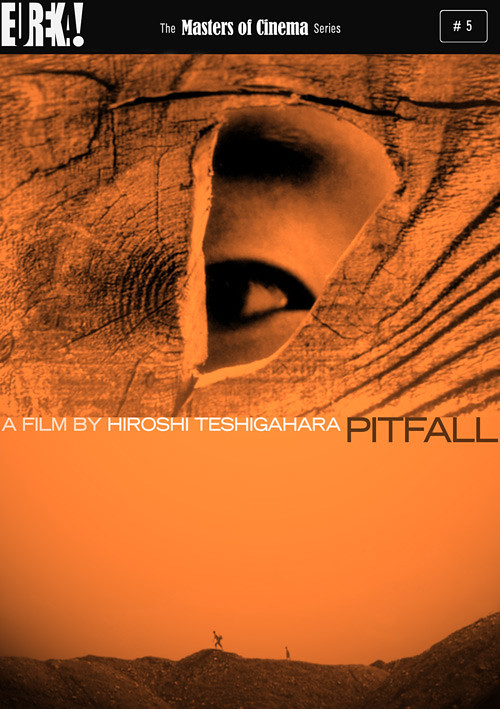
おとし穴 (Otoshiana / Pitfall)


It's funny that the first time I saw this the doppelgänger element stuck with me so well but I'd forgotten entirely about the ghost-story element. In fact the Criterion essays describe this more than once as an "anti-ghost story."

Man, Hiroshi Teshigahara's trilogy of Criterion-released films -- this, Woman in the Dunes and The Face of Another -- are films I'm always trying to convince others to watch. Seems like nobody knows about this guy. Japan had their own Kafka (Kobo Abe), and that guy wrote some films, and those scripts were directed by a master of low-key surrealist-drama! Of course they're amazing, and of course I love them.

It's great how our hero seems at first obsessed with justice for his murder -- and how the other ghosts wave this off coolly, saying everybody thinks like that at first, and warning that the more he learns the more troubled he'll be -- but in the end all any of the ghosts want is some kind of explanation for the cruelty and suddenness of their own demise. But there are no answers for them, no concrete ones; life is what it is, and forces bigger than you and tangential to your life will one day brush up against you and snuff you out, and there won't be any reason for it that you'll ever understand. Plus, as the other ghosts point out, once you're dead what does it even matter what the reasons were, or if the living discover some kind of truth about you? My friends, this is textbook absurdism right here, and I love every existentially cynical moment of it. Admittedly, that's not everybody's flavor, but for those it is, it's a wonder they haven't seen these films.

There is also the wonderful recurring theme of doubles here, binary pairings throughout. Ghosts to their bodies, the man and his double, the two unions at war, the man and his son. Almost everybody in this movie is partnered up so we can chart a continuum between poles. The three notable exceptions I can think of are the boy at the end, cut loose from his father (and his father's double: how confusing that must be, plus then to witness four murders!); the woman for much of the story, and look how psychically adrift she was for being without the "friend" she expected to write her a letter and save her from purgatory; and of course the man with the white gloves, the agent of chaos, the true killer and schemer. I could postulate all day about what or who exactly the man in all white represents, but the very point of the whole thing is -- all mysteries and wonder aside -- I can never know.

14 April 2010

The Others


Only two years after The Sixth Sense comes another movie with a big famous twist ending, an ending so similar it's almost impossible not to compare the two films -- especially when you watch them only a couple of days apart. The reason The Sixth Sense works, ultimately, isn't because its twist is clever. In fact, the handling of the twist in The Others is cleverer, for what it's worth. No, the reason The Sixth Sense works is because I care about the characters and the story being told. I like Cole and Dr. Crowe and Cole's mom. They are nice people who've suffered, and I want them all to find the things they're looking for. I never feel that way about Grace, Anne or Nicholas in The Others. I never even come close.

Look, I'm pretty forgiving about characters, and I know that once it's all revealed there's a "good reason" for it, but it doesn't change for a second that these are all unbearable, ice-cold, emotional-uncanny-valley half-persons from the very beginning, nasty to the servants and nasty to each other, and that sours the journey for me. Every moment spent with Nicole Kidman was an exercise in endurance and patience. The only actress with personality was child actress Alakina Mann, but she was more precocious than likable. I get why you give me these mysteriously dead-eyed people, but I don't get why you might think I'd enjoy them.

Here's my SPOILER to a nine-year-old film: I quite like the idea of watching ghosts who don't understand that they're doing the haunting, but everything about the reveal and the long monotonous series of clues we go through to get there killed the fun of it for me. Knowing there was a puzzle to solve makes it easy to see the end. I don't think that's to the film's fault, per se. (Husband Charles shows up around an hour in; if by that point you're still in the dark, well, it's not because the filmmakers were keeping you there.) But you've failed me -- the audience -- when it feels like a task to trudge through your story. The bottom line is, this movie didn't work for me. For my money, The Others was neither creepy or scary. It was tedious. I haven't checked the clock this many times in one movie in a long time.

07 February 2010

Out of Sight


Watched this to help me write (same with Collateral) -- watched it with a focus on scene construction, crime-drama stakes, and especially characterization and subplots. The idea is, every scene ought to advance character, plot, and theme, and if it doesn't you should really take a look at it. Without question, Out of Sight passes that little test.

Every single character is so distinct and has such a distinct trajectory... this is what I'm aiming for. This is what I'm trying to learn how to do... or how to do naturally. How to make it look as effortless as these guys do here. (Okay, this post comes more from the writer in me than from the moviegoer in me. These things happen.)