31 May 2010

No Country For Old Men


Still watching in a slight haze, so again I have less to say than it deserves. Especially for this one. No Country is just about a perfect film. It's got nonstop action, it's smart, it's driven by a momentum that never lets up. As always, the Coens have written some of the sharpest, coolest, stylized-but-not-too-stylized dialogue I've heard ever, and yet the action of the story is almost entirely silent: three sharp-witted professional men moving along isolated trajectories, ricocheting off each other in a deadly pursuit. It's a chase film, and it's the best chase film I know, where Good Guy, Bad Guy, and Cop all get their own stories. Llewellyn is a survivor, not very intelligent but incredibly smart and self-aware, a hunter and soldier and cowboy. Chigurh reads to me like a man furious with human beings, sick to death of them, and coldly obsessed with considering himself more of a force of nature -- of fate even -- than a man. And Sheriff Ed-Tom is, well, the soul of the film. The sad introspective eyes of a man who's only introspective because it's the winter of his days and this is not the world he remembers, or wants to leave behind.

Every time I watch this, I want to give more thought (and therefore more words) to the Missing Reel death of Llewellyn, but today's not the day for that. That's all right, a movie this phenomenal, it's not like I won't be watching it again soon.

27 May 2010

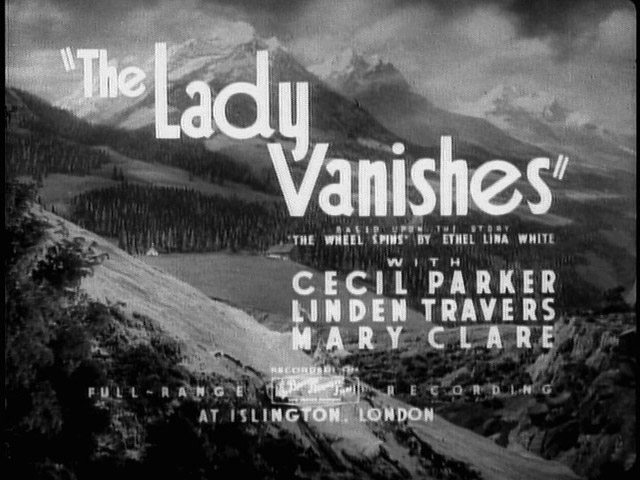
The Lady Vanishes *


I've said this so many times, even I'm bored of the discussion, but I am a bigger fan of the middle years of Hitchcock's body of work than his more famous later, Hollywood years. Here, the craft is significantly looser, and the story isn't trying quite so hard. In its place is a lot of relaxed fun and silly moments surrounding a just-so plot of disappearance and espionage. I don't have as much to say about this film as I sometimes do, partially because I'm in the middle of moving and haven't slept much lately and so I'm a little distracted, but partially also because this movie doesn't spark in me any instant thoughts I need to write down. Or maybe I have some things to say, but I'm too unfocused to channel the thoughts in any particular direction or into any specific thread.

To wit: It's funny and it's thrilling all at once, and the moments of awkward humor or my-aren't-British-people-stuffy humor are great, and it's pre-WWII tension is smart and exciting. It's got a funny and fresh-feeling "meet cute" between the man and the woman, and the scuffle in the storage car with the magician is pretty fantastic stuff. For my money, and by my spoiled ("savvy"?) critical eye, the story is too obvious and too easy, with uncountable coincidences propelling the plot, and it doesn't make the audience work for much. So it's not perfect. But it is fun, and it's got the oddest tone, straddling screwball and suspense unabashedly. So there, that's what I thought. I apologize (to myself? or anyone who stumbles upon this?) for being so scattershot, but I saw the film in a scattershot state, so I react to the film likewise. (It's going to be a long month.)

Seen at Laurelhurst Theater.

24 May 2010

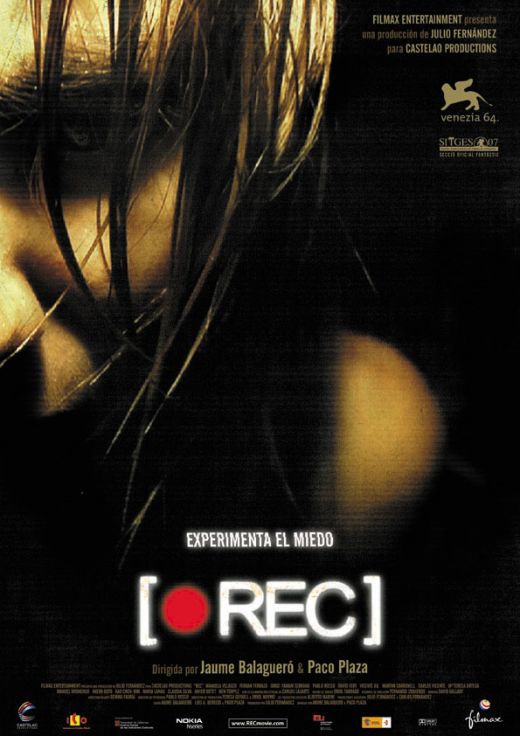
Rec


I wish I'd seen this in theaters. I'm starting to realize watching movies on a medium-sized television screen in a dimly lit room while I eat buffalo wings and a cat chases a moth around just isn't the ideal environment to be scared in. But I'm not going to let this film off the hook that easy. Much of it was so chaotic, with screaming bloody-mouthed monster-people lunging at an all-too-conveniently-held camera but never really biting, and that just wasn't scary. It was exhausting, and a bit tense, and even dizzying, but much of what was happening could have been scarier. (The little girl, for one, and the handcuffed mother for another.)

But -- credit where it's due -- Rec is a lot scarier than most the films I've been trying out lately, especially as it ramps into its pretty stellar third act, which although a touch cliché was well done enough it didn't matter. What I liked best about this movie, though, wasn't its ability or inability to scare me; it was the unfolding of its story in nice layers. Elements that feel placed for one reason (a sick little girl who needs her antibiotics, but they're trapped outside...) sneak back to mean something bigger later on (she's infected from patient zero, the dog). Answers to questions (the dog is how they found out about the infection, so the dog is somehow the source of it) are incomplete answers that hide deeper ones, allowing them to come up as mild surprises later on (the mysterious man in the penthouse kept alive a young girl who is the true patient zero!). It's all very clever. The peril and the chaos -- I didn't hate them but they didn't do it for me. The mystery and the story, I quite liked.

I also got to pay close attention to some of the same old tropes, and what does and doesn't work for "scary." People coated in zombie makeup, not too scary; barely revealed anorexic actress wandering around nude trying to eat your face, only seen in hazy glimpses, notably scarier. The darkness alone, not too scary; the darkness when you know something is out there and all you can hear is panicked heavy breathing, notably scarier. I'm curious to see the American remake, though I hear it's not very good. I'm also curious to see the sequel, Rec 2, which to be honest I take for granted isn't very good.

23 May 2010

It


It is an interesting movie. On the one hand, the horror scenes are so obvious, and the cast so... well... "TV," that it doesn't get much of a rise out of me. The photography is flat, either soft walls of white light or that sharp directional full-spectrum of filters and gels that screams amateur video or 90s TV show. Neither mode suits the mood just right, and it's a shame. Because despite all of this, the story is really good, and the actors aren't so much bad as they are broad, with silly dialogue and a lot of "As You Know, Bob" conversations. (Oh, and that pet peeve of mine I just recently went on about, the Flinch-From-the-Force-of-the-Flashback trope, mixed here with the I-Have-No-Memory-Of-That-Until-It's-Plot-Specific-For-Me-To-Do-So trope.) But otherwise...

Part one is the kids' story, and the flashforwards to the adult versions just exists to enrich and bridge gaps. Part two we flipflop, and it's the adults' story, with occasional flashbacks to childhood used to enrich or bridge gaps in the other direction. It's all nicely symmetrical. And Tim Curry's Pennywise is as charismatic and evil as you want him to be: one part psycho Joker, one part Freddy Krueger, one part Beetlejuice. The thing of it is, with the broadness of the storytelling and acting (and remember, this was a made-for-TV movie in 1990, on ABC; by those standards this really is a fucking amazing piece of work, worthy of its reputation), with the themes of "fear is contagious, but it's only in your mind" (placebos!) and "together we are stronger than any of us apart" and "the power of faith/belief is our weakness and our strength," well, It ends up feeling like the target age group is the ten- to twelve-year-olds, not the adults. It's a scary movie for kids, and to that it's legitimately one of the darkest, actually frightening movies for kids I can think of. But as an adult, it's all a little easy.

And honestly? Fighting the spider as the climax, and beating it because Bev took a third shot and then everybody kicked it in the tummy? That was a shitty ending. You want to see Pennywise win or lose. You don't want to see a hard plastic monster that looks like a He-Man toy shot on a macro lens lying on its side.

It's good. It's good, I should say. But It's not mind-blowing. And the childhood story is exactly the kind of broad, easy stuff that I was just praising Small Change and I'm Not Scared for NOT being. But it's -- sorry sorry, It's -- still a pretty damn good film.

MacGruber *


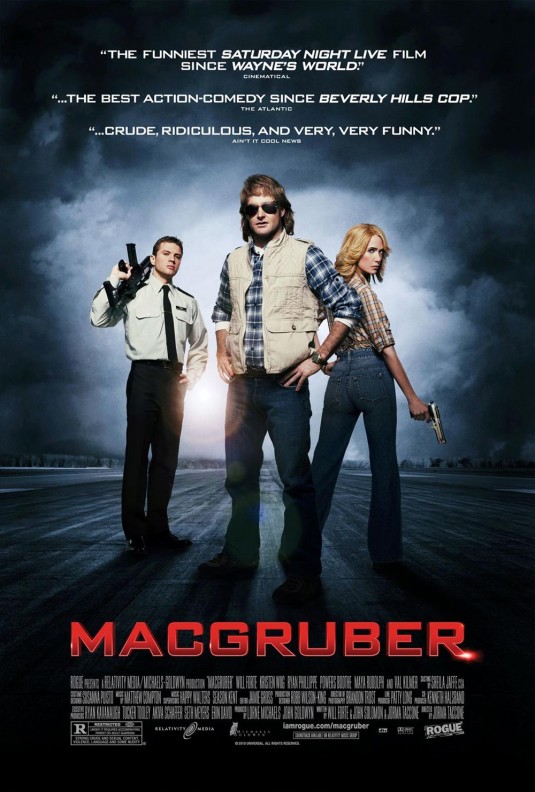
There is a quote on the poster above, used everywhere for this film in fact, which if I'm not mistaken is a pull from the review written by a friend of mine, that calls MacGruber "the best SNL movie since Wayne's World." I'd say that about sums it up perfectly. If only that bar weren't so low. The film is fun and watchable -- I only laughed out loud a couple of brief times myself, but I'm a bit reserved when it comes to comedies; I don't mean to be, I just am -- but the aesthetic of the film actually made me a little uncomfortable. Like, it did a pretty great job of hitting what I felt it was aiming for, but I didn't like what it was aiming for, personally. In all truth, the humor made me grimace as often as laugh.

The film is smart enough to take itself very, very seriously, to never pull that Mel Brooks trick of winking to the audience (it works beautifully when Mel Brooks did it, but it wouldn't have worked here). I liked that. It knew what you expected to happen and it subverted it in ways you didn't expect, even when you expected your expectation to be subverted (if that makes sense). In short, even though I kept thinking, "this is really well done," I couldn't help but feel kind of bad for Ryan Phillipe, Powers Booth and Val Kilmer for being in this movie... and that's sort of not a good sign.

Anyway, the bottom line is, I pretty much liked it -- but if I'd been seeing a lot of really amazing Hollywood films (and comedies especially) lately, I'd probably just call this weak and silly and that'd be it. Since I haven't seen a lot of great Hollywood films lately -- in fact I only went to see this because nothing else was playing -- I can't help but grade on a curve here.

It's sad. Is that where we're at? Is that the state of film in 2010? If Hollywood makes it we start awarding the mediocre (with my dollars, at least), because it's better than the rest of the shit? Is this an A-for-Effort world we're living in? I think it might be. And that's depressing.

Seen at the Lloyd Center Cinema.

19 May 2010

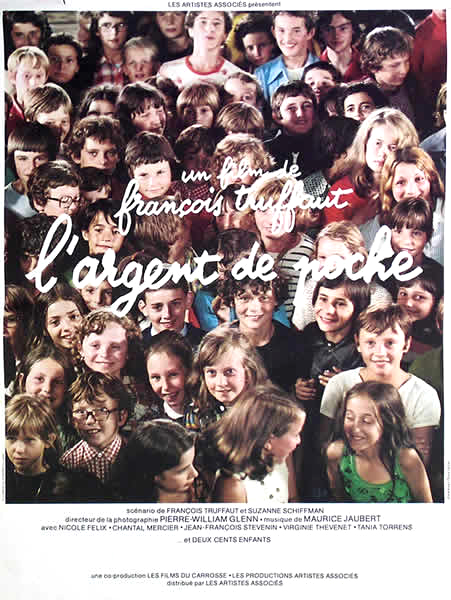
L'Argent de poche (Small Change) *


It's amazing to take my childhood experiences and compare them to American films about children vs. European films about children. If you didn't know better, you'd think American kids were wholesome cuties incapable of nuanced emotion, confusion, fear, lust, or envy. But I was an American kid, and I know much, much better. Watching something like I'm Not Scared and even moreso this film, I'm embarrassed by how little we address or even acknowledge the childhood experience in American art and media. I've tiraded before about our puritanical denial that a sexual impulse might enter the head of anyone less than seventeen and eight-eights years of age, but this is so much deeper. Just simple things: envy, doubt, fear, experimental cruelty, deceit, self-denial, exploration of social roles, resilience, determination, actual innocence, bemusement. Is there an unspoken rule that children can't experience life in a film?

Anyway, I seem to have gone off topic. Small Change is an interesting story, because it's got almost no structure at all. It repeats itself a little bit, allowing the same kind of situation to unfold to one character after another with different variables and different results. Events lead characters around corners that go unexplored. Everybody develops and adapts but not down a singular, controlled path. There are no "arcs," in a simple sense. The world exists just as abundantly beyond the edges of the frame as it does where the camera's pointed. And the film isn't afraid to scare you while being cute, to creep you out while being charming.

I am about to write children doing children things, and before seeing this I wasn't really cognizant of how young and naive a 14-year-old (for example) really is. It's so easy to write the words STACY (14)... and then to imagine someone roughly seventeen or eighteen, and then to write a character who's essentially twenty-one or twenty-two. Fourteen is a kid! Eight is a little kid! This both terrifies and thrills me as I move forward with development. It's certainly going to make casting a bitch, but I think it's going to be worth it if I can pull it off.

Anyway, I'm really glad I got a DVD copy of this. I'm going to have to revisit it. Hollywood and America in general refuses to acknowledge anything genuine about kids and their lives, so I thank my lucky stars we're not the only voice out there. Truffaut seems to know a thing or two about childhood, and this film is a beautiful, amazing, nuanced tapestry devoted to that very subject.

Seen at the Hollywood Theater.

16 May 2010

Cujo


I'll be honest, I almost don't want to include this on the list. I just couldn't force myself to pay attention to this movie, and I almost hadn't noticed it was over when the credits started rolling. I wasn't asleep or anything, I just sort of... zoned out. I understand the difficulty of working with an animal, and the limitations of making it actually appear savage and vicious and bloodthirsty. But there's just something extremely sedate and, well, mopey about Cujo's demeanor that no amount of asynchronous looped-in dog growl noises can make up for. I never once find the dog scary. Just gooped up and gross. St. Bernards just aren't all that terrifying. Unless you hate slobber.

The editing seems smartly done, working up as much tension as possible during the dog attack scenes. The sound design is leaned on heavily here (not exactly unique among horror films) but the main name of the game for how-to-scare-you here is chaos. It's like a savage energy, but instead it's just kind of... chaotic. Plus, I'm not sure I get it... he's just a big rabid dog, right? He seems kind of smart for a dog, especially one with "rabies," but not exactly reasoning-smart... I don't get how he manages to kill everyone so easily.

I didn't hate the movie or anything. It felt very Jaws-y to me. It's just a victim of that 80s-era flat photography, goofy acting, and shallow storytelling -- and it's got a nonscary monster/dog. It gave me a little to think about in terms of how menacing a menace needs to be to work, and how a cognitive dissonance between intention and image (or sound and image, even) can really bring you out of the picture, and with any experience you want to be visceral, once you're brought out it's almost impossible to unburst that bubble. You can't go back in, and if you're not inside the picture you won't be scared, or moved, or anything.

I'm finding myself to be one hell of a harsh critic of this genre, but I'll also admit that despite tearing these things apart, some of the films are staying with me more than others. The Mist is sticking with me a lot more than I'd have predicted, but The Others left so little impression I can barely remember the plot. I wonder if I'm too harsh on horror films, but I think I'm just a discerning dramatist who wants themes and character to go along with his plot, and for the most part horror films want to be popcorn movies. But I think know any film can be more than that, can even in fact be a popcorn movie and a thoughtful piece of challenging film. Sure, it's rare, but it's the goal. You make art, you want to make good art. Probably even Bret Ratner wants to... no, I better not finish that sentence. I don't believe it myself.

Anyway, I'm not lowering my standards for horror films, but I'm learning even from the ones I don't like, so there you go.

13 May 2010

The Mist


I want to take this seriously. For one, because I've been really interested in the Lovecraft side of horror lately, and this aims for that more than any other horror film yet (beating out The Thing, just). For another, it's got a bunch of people trapped in a building with scary unknowns right outside trying to get them. This is the core structure of my next project. For a third, every forty-five minutes or so it stumbles drunkenly into a moment that, in different hands, would have been astounding.

But this film is god-awful bad. This isn't the aggressive mediocrity of Robin Hood or A Nightmare on Elm Street. This isn't goofy B-movie bad either, which The Thing and The Host both dabble in artfully. This movie... every scene and beat and action and line of dialogue is a misstep. Honestly, the only films I can compare this to are The Room and The Happening, and that is not good company to be in. All three of those films seem to have been put together by alien creatures who've never seen real human interaction, don't quite understand it, hope they can fake their way through. If you told me the Old Ones from H.P. Lovecraft's stories had come from another dimension and wrote this story, and then directed this movie, I would believe you.

So I sat through it, and it was pretty unbearable, but the thing that really kind of upsets me is that it touched on all these great things in a way that kind of sullies them. Monsters in the fog, massive interdimensional tentacly things (how many times can I mention H.P. Lovecraft here, you think?) -- and a pretty cool ending: Alone in a car (we'll deal with plotholes in a moment), surrounded by thumping and roaring and trudging dinosaurian things much, much larger than the boring old space spiders and dragonflies that were annoying them earlier, not enough bullets in the gun and nowhere to run to. Most importantly, the world has forever changed. It's a good place to end a story. But it doesn't make this a good story. This is a bad story. More to the point, this is a bad story that makes it hard to tell another story with these elements, because of guilt by association.

What do any of these people want, at any point in the story? Can anybody point to a single scene where the characters react in believable ways to the action around them? (Even the screaming feels weird and fake in this film.) I don't even want to talk about the way peril comes and goes at the whim of the writer/director and clearly follows no pattern of internal logic within the story. Nothing does. If you can't tell, this kind of left me a little bit angry. I threw up my hands early on and had a hard time trudging through to the end. The characters were painfully artificial. Norton's insistence that it is a "prank" or "lie" to make him look bad is preposterous, to pick one specific early example. Characters in this don't have arcs, they have arbitrary interactions that contradict subsequent or previous interactions as likely as not.

Such a waste of a deeply unsettling ending, a couple of really beautiful shots, and some fairly creepy monster ideas. Such a goddamn waste.

The Night of the Hunter *


After the movie, my friend Rachel asked me to define "film noir" for her. It's one of those things, like defining deconstruction or pornography, that is hard to pin down, but easy to know when you see it. I did my best. "The world is very urban, seedy, populated with criminal undergrounds and late night hangouts. The protagonist is an anti-hero, a man whose soul is lost to some prior sin or crime but who fights for his personal convictions and -- basically -- commits sins or crimes in order to protect other, less 'lost' souls and help them avoid a similar fate; they trudge through the muck willingly in the name of keeping the muck at bay. Women are sexually or romantically alluring creatures, but giving in to temptation 9 out of 10 times leads to betrayal, and 1 out of 10 times leads to their death. Children do not exist, because they represent hope. And it's shot in stark black and white, making grand use of shadows and expressionism. Oh, and they're mostly all morally ambiguous stories where nobody is 'good' and most everybody is a little bit 'evil' and we take it for granted, and they all came out during the tough Depression/early-WWII times."

So then I compared that to The Night of the Hunter, a 1955 film that takes place during the Depression. Well, it's shot in grand, shadow-heavy black and white, and leans heavily on operatic compositions and expressionistic sets. The world is all suburban and rural, though there's a lot of conspicuous neon sprinkled throughout to remind you of what it's not: urban. The main character (the antagonist, actually) not only lacks any broken-spirit from past sins, but revels in them still; further, he's a goddamn preacher, a "risen man," morally speaking, though it's obviously a show or perversion of such a thing. He speaks and acts as though he is committing acts of righteousness but he does it in the name of sin, crime, and muck-causing. The film is packed with women, but every single one of them is a mother or motherly. The only love in the story is young Ruby, who falls inexplicably for Preacher Harry Powell. Not only do children exist, they are the protagonists, and although the story is one in which hope is repeatedly taken from the poor kids, they also undeniably represent an endless fount of the stuff. They are hope springing eternal.

In other words, this film is the ultimate anti-noir film. It is everything the genre is supposed to be, turned upside down and inside out. Some of the dialogue is a bit spot on or blunt/unsubtle, but for the most part, it's bloody brilliant. And reasonably scary. And staggeringly beautiful. So many shots were just haunting. (SPOILER) The long hold on the corpse of the mother underwater, hair and dress and seaweed waving, will stay with me a long time.

Also, child protagonists trying to be tough and stay strong with scary grown-up shit happening to them: yeah, this is a pitch-perfect film for me w.r.t. one of my current projects. So there's that, too.

Seen (a remastered print!) at Laurelhurst.

12 May 2010

Robin Hood *


I don't know where to start. The script feels obvious, formulaic and transparent in the worst ways. Every scene feels like an index card of what a scene needs. It even had a save the cat moment for Robin, a painfully unsubtle "look, our sourpuss killjoy protagonist is a nice guy after all!" moment. Scenes are crowded with characters just so they can be shifted around the board and ready for their next scene later on. Dialogue is rarely so beautifully leaden and expository as it is here. And the pacing! By the end you get that you're not watching a Robin Hood movie so much as an "origin story" for a Robin Hood series or franchise (that, god willing, will never come to be), but it still leaves you with the strange feeling that you just watched a 140 minute act one. Which isn't a good thing, clearly.

The story itself is exhaustingly predictable. Every single beat feels like it drags on, and as a viewer who is actively trying to lose himself in the story and just enjoy things, it's too easy to be three beats ahead of the narrative. I'm still watching the king give a speech and I'm already seeing both his death and the subsequent crowning of a new king. I'm watching Robin Hood meet Max von Sydow's Walter Loxley, and I'm already anticipating the reveal of his childhood past (though admittedly, I didn't think they'd resort to my singlemost reviled film cliche, the physically-flinching-from-the-intensity-of-a-flashback scene). It hurts to sit there and wait for the film to catch up with you, and by the time it does you're three steps ahead all over again.

But beyond all of this, the thing that stands out is the bizarro-world third act, which (SPOILER) involves every single character doing a personality 180 for the sake of satisfying a maximum of action movie cliches. Lady Marion becomes Eowyn. Friar Tuck dons chain mail and becomes another warrior in the "epic battle." Peter Pan and his Lost Boys Lord of the Flies kids joins the fight. King John grows a pair and becomes a noble leader. William Hurt's William Marshal (and everybody else in all of England) kowtows to some peasant-kid turned archer turned knight-impostor turned William Wallace, declaring that "France has surrendered... to him!" Robin himself becomes... I don't know... Gladiator? Lame? Boring? No, I guess there's no change there. Oh, also, we're subjected to shot after shot of whimpering, cowardly French, the bad guys (sort of?) dying pathetically as victims, in the middle of -- well, let's just say it, The Invasion of Normandy. Oh, right, and then somehow the film becomes this big long really unsubtle Socialist Diatribe. Weird.

So, yeah. Historical detail to weaponry and warfare was okay. Everything else felt straight-up Screenplay Mad Libs. And Russell Crowe is just as uncharismatic and marble-mouthed here as anywhere. I'm sorry, but it is absolutely impossible to believe this filmmaker once made Blade Runner and Alien. This film, like all his recent work (even the "good" ones like Gladiator and Matchstick Men) has no personality and no vision. It just, blandly and generically, a movie.

Seen at Lloyd Center, with a couple of film critic friends, and I'm very grateful I have no responsibility to be fair or thorough in my assessment. I just like to drop my impressions in a disjointed ramble, call it done, move on.

10 May 2010

M*A*S*H


I keep saying my script is "in the vein of Dr. Strangelove," but in some ways it's just as much kin to M*A*S*H as anything. After all, Robert Altman's the master of the twisted ensemble and this film and it's spin-off TV series are still the reigning kings of mixing absurdist black-comedy with bittersweet tear-jerker moments. I think my character Ben Vanberg, repeatedly described as "a Max Fischer type," could stand to have a little more of the Duke or Hawkeye Pierce attitude in him, as could his brother Vic. Though I'll admit, in my story the nihilism doesn't have the poignant punch that M*A*S*H has. In my story it's almost an end unto itself.

Still, the Fuck-Em-If-They-Can't-Take-A-Joke attitude not only makes Hawkeye, Duke and Trapper John a delight to watch, it makes them easy to sympathize with. The moments of surprise, when the characters prove deeper and more thoughtful than you expect them to be, or more humanistic or empathic (they are doctors, after all) may be the story's saving grace, dramatically. Especially when they're so cold, like cruel children or insensitive frat boys, about punishing and tormenting their adversaries, especially Major Burns and Hot Lips. They're sexist, chauvanist, arrogant and entitled, and yet we love them, because in the face of all this war and cruelty, what could it possibly matter? Who wouldn't be cynical? They at least have the balls to face the horrific reality around them and keep a smile on their faces. Dramatically, this makes them good protagonists. And to an old-school absurdist like myself, it makes them absolute heroes.

Now. How do I translate this into my script? By keeping aware, I guess.

In rewatching this tonight, I realized how much I've conflated this film with Catch-22. I'll have to watch that one later. Also, if I may say, I get why it's a brilliant idea to make the story's climax a big rousing football game with ringers and bets and men bashing men in pristine brightly colored football uniforms -- I get why on several levels. But I still always find the sequence too long and too boring. Beyond showing my hand about my reticence to spectator sports, I'm not sure that means anything, but every time I watch this I find myself drifting away and watching the clock before the second half of the big game. So it goes.

09 May 2010

Iron Man 2 *


(I'm posting from my family's house during a lull in a Mother's Day celebration, so I'll be brief.)

Interesting. Thoroughly palatable, but the action scenes felt even more forced and cartoony than the last one. The fights our hero has to make it through seem surprisingly easy, bloodless, and apart from architectural damage, consequence-free; and every time Iron Man is backed into a corner he just pulls another Magic Doohickey out of his utility belt built-in armament. At no point does it feel like anybody dies or is at risk of dying.

The character stuff was better. The story's a little crowded with characters and subplots, but it never feels clunky because of it, and it moves at a fast clip that never leaves you bored -- well, except perhaps during some of the exhausting, sterile action sequences; namely the race track fight with its Happy-and-Pepper comic relief duo silliness and the final showdown in Willy Wonka's factory (or wherever that was supposed to be) with all the Imperial stormtroopers Hammer drones and Whiplash or whoever that was. But the whole thing does feel lighter and chewier than the first one. It starts to explore governmental control and the responsbility of power and the price of peace, but then it lets those things go so it can have a big silly flying chase scene. Alas. In short, the movie is complicated but not clunky, but doesn't have much to say except, "Let's have fun." I'm not faulting it for that. It's Iron Man 2, for god's sake. I'm just stating facts.

Side note: Mickey Rourke is almost as fun to watch as Robert Downey Jr. (come to think of it, so is Sam Rockwell and Samuel L. Jackson; and Paltrow, Johansson, Gregg and Favreau are all smartly played bit parts), but what I want to mention specifically is: Rourke does a hell of a good (fake) Russian accent.

It's interesting to see the party line coming in, building different movie series toward the Avengers film, and though I've always found the Avengers to be boring (though I've never read any of Bendis's revitalization of them, and I do like Brian Michael Bendis...) I do kind of like the solidarity of the movies as they move forward. It's clever: this means I'll probably go see Thor, even though normally I wouldn't give a crap. My point is, good for them. Plus, it felt intelligently woven into the story, not shoehorned in to build a franchise.

Anyway, I just realized how much I can say about this one movie, because I have a triggerfinger geek side. But like I said, it's family time and this is already long. Enough is enough.

Seen at Bridgeport Plaza's Regal Theatre.

02 May 2010

The Aviator


The first time I saw this film, I remember being preoccupied with how bloated it was -- too many events, too episodic, more bio- and not enough -pic. I remember saying of this movie and of biopics in general, "It's less a single story and more a series of 'And then that happened, and then that happened, and then that happened.'" I didn't hate it, but I didn't care for it either. Watching it again, though, it seems like pure Scorsese, the venn diagram of stylistic nutbaggery like Bringing Out The Dead with the more visceral stuff like Goodfellas and Raging Bull. Plus, it's the story of a man driven (among other things) by a firm and auteristic ego to make films his way, which gives the first act a nice touch... maybe it's not autobiographical, but it still makes Hughes and Scorsese kindred spirits. Scorsese's vision of Howard Hughes is a fascinating, frightening man, and his descent into the famous Howard Hughes madness is great.

Mostly what strikes me though is how expressionistic this is, how nonliteral. It's a colorful whirlwind of visual metaphor and inner worlds made physical. This isn't a big Hollywood biopic; it's a fairly insane art film, something like Natural Born Killers or even a Lynch film. And to that end it's quite a lot of fun, even if the story's massive and epic and spans decades longer than my movie-watching instincts want it to (sounds familiar, actually: like a little project I'm obsessing over myself). Also, Leonardo diCaprio feels young for the part, but his performance as a psychically disintegrating Hughes is one of his better roles. And he does look a little Hughesy with that mustache.

There is, however, an awful lot of Woody Harrelson's Larry Flynt in there, and that leads me down a rabbit-hole I can't get back out of: there are enough parallels between this and The People vs. Larry Flynt to be suspect. A self-made southern man, driven to buck and defy the status quo in pursuit of a dream, becomes a giant in his industry and a threat to the old guard. He becomes embroiled in legal troubles which he turns into a media circus. He suffers a major accident which leaves him with a broken body and a stronger-than-ever spirit. He never takes no for an answer, at his own and his loved ones' expense. He is surrounded by a crew of brilliant character actors who trust him implicitly, no matter how crazy he gets. And in the end, he fights for a crucial American institution (in Flynt, free speech; in Aviator, protection against monopoly) and exposes political figures as lapdogs to corrupt groups (Christian coalitions in Flynt; Pan Am in Aviator). I mean, both even end on a similarly nostalgic, bittersweet note: one has Flynt watching video of the love of his life, still alive and happy, as he speaks wistfully to her ghost ("we did it, Althea, we did it"); the other has Hughes fighting off another tic ("the way of the future, the way of the future,") and seeing a vision of a young, unspoiled, ambitious young Howard Hughes in the bathroom mirror speaking with the ghost of his mother. I'm not saying Scorsese ripped off Milos Forman here, but there's no denying that the maps of these movies have similar terrains. I guess that's your American Figure biopic formula for you, huh?

01 May 2010

Notorious


Mr. Smith Goes to Washington left me hungry for more Claude Rains, so I rented and watched this. I continue my love-hate relationship with Mr. Hitchcock, but this falls in that early-mid category and for the most part, it works. There's a little bit more shorthand than I'd like in some of the emotional-setup moments (notably the agreeing to be a spy and falling in love beats feel rushed), and quite frankly Cary Grant feels even more stiff and robotic than usual, but the situations are wonderfully tense and clever and sticky. The character motivation is clear and their actions are interesting. The whole story hinges on Devlin lying about his feelings out of a sense of duty (and resentment of those feelings), and Alicia going along with it even though she knows better -- because what's the value of being loved if your lover won't admit their love to themselves, let alone to you?

Claude Rains and Ingrid Bergman, fantastic. A little funny watching a romance play out between Ilsa and Renault, but Rains felt and looked a little more like Albert Finney than he did a French Captain. Plus the chemistry (and lackthereof) was so nice, it felt real, and you could easily sympathize with our villain's plight at the end, betrayed by his love -- and by his own hubris. I couldn't help but wonder, especially in the context of Alicia's constant acceptance and encouragement of his love in the face of Devlin's stubborn stoicness, if Sebastian might not have accepted her love anyway, even if he had known she was using him. Surely not, with so much at stake, but it left me thinking about accepting the love that's given versus holding out for the love that's withheld. Whether or not Alfred Hitchcock wants me to be considering this while watching his tightly scripted espionage thriller... well, your guess is as good as mine.

30 April 2010

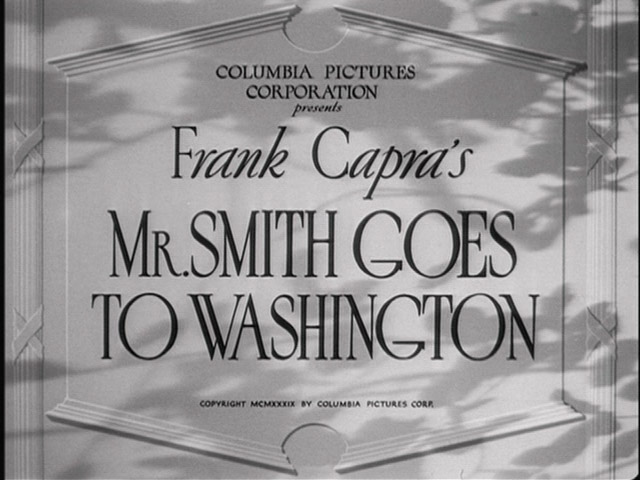
Mr. Smith Goes to Washington


Confession time: I've never seen a Frank Capra film before tonight. Yes, that means I've never seen It's a Wonderful Life, so I totally don't know whether or not George Bailey kills himself or what. But despite not seeing any Capra, I had a strong idea of what Capra was known for: baldfaced moralizing, big lessons. I don't mean that in a bad way -- I know he's loved and respected, but I also know he's famous for moralizing and lessons. What I didn't know before tonight is that he's also fantastic at simple characterizations and complex relationships, and while he does tend (in Mr. Smith at least) to beat you over the head with his point as though you were a dead horse, he also offers a point that's nuanced and complicated. Sure, the good guys are really, really good, and the bad guys are pretty dang awful, but the situation isn't easy and the solution -- well, the actual solution isn't easy. More on that in a moment.

Mr. Smith moves along at a great clip, two nonstop hours of humor and heartwarmingness, and like I say it's got some really fine moments, just tiny things (Smith and his hat; the piggy congressman stuck in the phone booth; Diz and Saunders drunk) that sell you on his people, make you kind of love them. It isn't afraid to be funny every chance it gets, and I think Capra knows that's the sugar that makes his medicine easy to swallow -- but what's more is, he lays out a complicated, interesting, concise world, and that's what (for my money) makes his medicine worth swallowing. Even when Smith is filibustering, totally and unequivocably and 10,000% on the side of Goodness, he is portrayed as cut-off, detached from the citizens he cares so much about. And they from him; they depend on the media to have any idea what's really happening in Washington, and for various reasons throughout the story (often greed-related reasons, but occasionally for more sly motives like sensationalism or good old mocking the suspicious new guy) the media is shown to be scandalous, inaccurate, or downright deceptive. There is the citizenry and there is the government and the bridge between them is a rickety and fallible one, and no solution to that dilemma is offered in the story here.

The "solution" to corruption in the Senate -- the attempted suicide and then berserker-confession of Senator Payne (the brilliant Claude Rains) -- which I admit is well-motivated, still feels rushed, thrown in last-minute, as if they were in a hurry to wrap things up and give Jeff Smith his victory. Still, I don't think Capra really believed that guilty senators held the key to the real life problems he was suggesting, and so not despite but because of his movie's easy, last-minute resolution, he makes the open question of what should be done about the problems he portrays all the more apparent. We can't guilt our dirty politicians into killing themselves or throwing themselves on the mercy of the Senate floor... So what do we do?

It's 70 years later. We still don't have an answer.

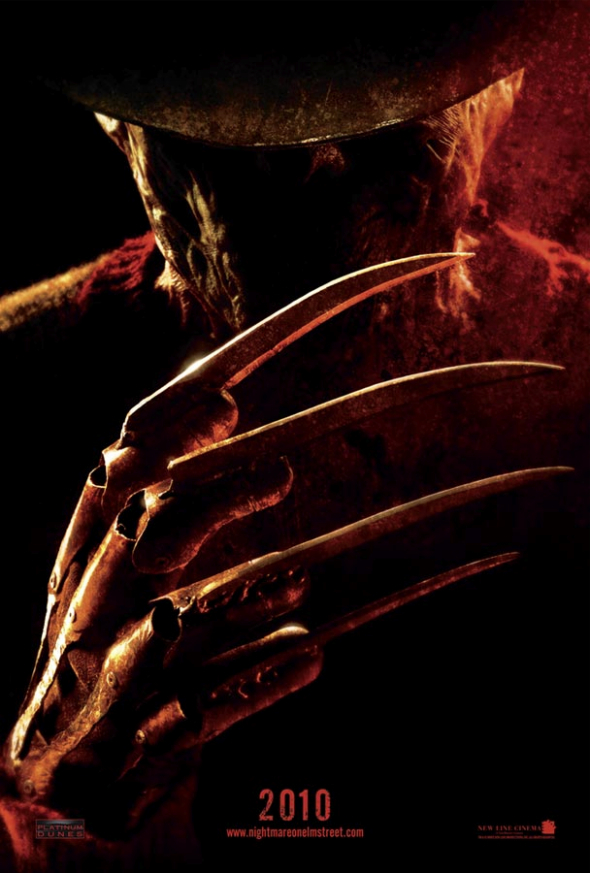
A Nightmare on Elm Street (2010) *


I was invited to a midnight screening of this and went with the expectation that the film wouldn't even be good by horror standards -- which more and more I am defining very simply as "legitimately scary" or "legitimately creepy" and ideally both. But I know better than to expect too much of either from a slasher film, at least a non-classic slasher film, so I went into it as research, as I have done to many films lately. My goal was to think about what makes a thing scary or not, which techniques work and which don't. Unfortunately, the only things this movie considers scary are jump-out-at-you shock moments which are always accompanied by a loud, sharp metallic burst on the soundtrack. Remember those rickety old carnival haunted-house rides where you sit in a little metal car and plastic skeletons leap off walls at you? Modern horror films seem to assume that those carnival rides are the ultimate experience of "horror." I didn't learn a single thing about how to scare you that I hadn't already learned elsewhere. Anticipation is fun, but surprise is better if you can truly pull it off. Videotaped stuff can be creepy. When in doubt, lean hard -- and I mean hard -- on the sound designer to beef up your scare factor for you. And if you can't scare 'em, just make 'em jump (it's basically the same thing). So it was a bust, in terms of research. And in terms of being actually scared (sure, I jumped a couple of times, but it was so LOUD how could I not?).

However: I don't want to go into a whole thing here, but I gave a lot of thought to the dramatic structure of this particular movie. Who's your protagonist? What do they want? What is the story's inciting incident? What is the point of no return into act two? What actions do they take to reach their goals and what stands in their way? And so on. I guess one answer to "who is your protagonist?" is, there are several, passing the protag-baton (which is not a sex device from a Woody Allen movie) forward every ten or fifteen minutes -- whenever it's time to die. The story begins when the kids begin to realize they're all having the same dream. What they want is the most basic thing in the world: to survive. What actions do they take? Precious little. All they do is react, over and over. Their occasional actions -- burning themselves to stay awake, shooting up pure adrenaline -- have zero effect on the story, not even affording them five more minutes of sleeplessness. It was pretty ridiculous, and hard to buy this group of bland pretty people as protagonists. They don't do anything.

The other answer then, is that the protagonist of the story, whose action drives the plot, who makes crucial choices and decisions, is Freddy. He constantly takes actions, makes choices, in fact he creates and populates the world of your dreams as far as I can tell: he is the master storyteller here and he holds all the cards. So what does he want? He wants to punish those who burned him alive by killing their children, sure; and he wants to punish the children who turned him in, yes; but more than either of those things he is forcing these teens down a path, luring them to the preschool they've all (all!) blocked out entirely, into his hidden sex dungeon, showing them recaps of his death and allowing a select few to pool their resources and know his story. He is telling his story. And for a while it seems he is telling his story because the children lied, or were confused, and that Fred Krueger was an innocent man. But no, he wasn't. He wasn't innocent of anything. And so, what's that leave us with? Well, as far as I can tell, the protagonist wants desperately to be given full credit for molestation and/or child pornography, and then he wants to kill the people who he's proven himself a monster to.

So, yeah. I guess I'm confused. Either that, or this is a shitty movie that doesn't make any sense.

EDITED TO ADD:

I know I'm already running long in this post, but it's my blog and you can't stop me. Anyway, I was talking about the protagonist issue of Nightmare with my friend and professional film critic Eric D. Snider, who actually gets paid for thinking too much about these things (the lucky bastard). Eric pointed out that one of his favorite films, Psycho, is arguably the source of all slasher films, and that Psycho's pointedly unique structure -- a twenty-minute misdirection where we follow a would-be protagonist who turns out to be prey; a bait-and-switch where we don't meet the story's actual protagonist, Mr. Norman Bates, for quite a while -- is exactly what's been hollowed out and aped by all the killer-stalks-victims movies of the last forty years or whatever. Bates of course had a distinct arc and was the ultimate anti-hero protag, and the trick of following a false-protag was deliberate and jarring. When Psycho was made, it wasn't intended to be the blueprint for a whole genre; it was supposed to stand out as unique. Everything it does, it does for a reason, and every "cheat" is to an end. But it's become a formula, and that's why the dramatic structure of the slasher film feels so damn weird. You are given a bunch of semi-protagonists who move the story along in fits and starts but ultimately just end up fodder for more killing, and you are given a mysterious killer whose backstory creates the ultimate framing piece and explanation for all the bland mayhem and hackery. ("Hackery," in this sentence, is a double entendre. I don't want you to miss that.) None of it means anything, and all of it is trying to capture what was magical and frightening about a 1960 thriller film. But each one is just a copy of a copy of a copy of a copy, and like xeroxing a xerox, all you end up with is a vague amorphous shape and no detail. It's disappointing, but at least it's interestingly disappointing. Or something.

Seen at Lloyd Center Cinema.

27 April 2010

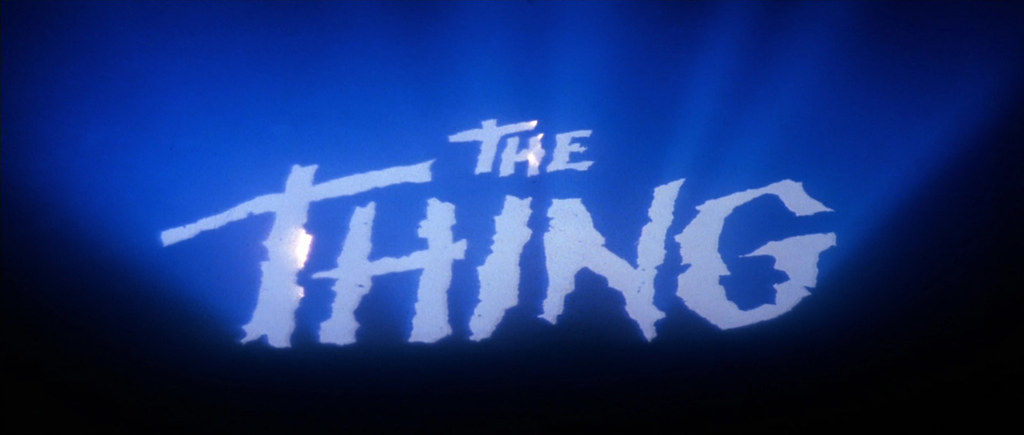
The Thing


I didn't grow up on "scary movies" or "gory movies" or anything, and I hadn't seen any Carpenter film until I was an adult -- not even Big Trouble in Little China! (Exception: Memoirs of an Invisible Man.) It's not like I was sheltered, exactly. My parents really don't like them and I never really took to them, so it never came up when I was a kid. My point is, I come to this without nostalgia, and The Thing is a pretty excellent film. It's smart. It's freaky. The effects hold up really well (the motion feels fake but the creature designs and models still look fantastic). But it's not very scary. It has moments, sure, but it's no scarier than Terminator or Predator. It's less scary than Alien, which I do consider a horror. The Thing is a horror in that it's a monster movie, but it doesn't instill or sustain any real sense of fear.

On the other hand, it's populated with distinct and realized personalities, and the action is entirely and always character-driven. And people react pretty realistically to the horrific things around them. Plus, it's equal parts Lovecraftian mind-boggling-horror and Dickian layered paranoia, and both parts are handled really intelligently. So it's a no-brainer I like this film. But the way I see it, it's not a horror.

I only bring that up because I'm seeking out scary, and I'm trying to figure out what is and isn't scary in a film. And the reason I don't think The Thing counts is that it's too explicit with its monsterness. It's creepy (a favorite is the famous spider-head), but I think it shows us too much to qualify as scary. I'm thinking of The Host and Cloverfield, but also Poltergeist and even Jaws -- movies with monsters retain the scary until the monster's nature (or form) has been more or less revealed, and then it's just "How do we beat it?" The Thing has some of that, I admit, but it plays out more like a mystery, with clues discovered systematically throughout. It's a procedural. And, like I said, it's smart -- and better than if it played out like a horror -- so none of this is a complaint. It's just what thoughts on the horror genre and my expectations from it I've had while watching a great science fiction movie with a monster.

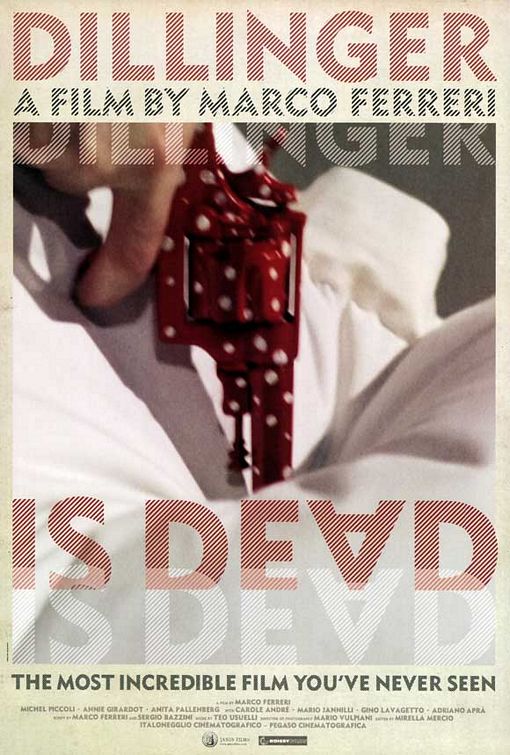
Dillinger è morto (Dillinger is Dead)


A film like this really shows you how limited the contemporary idea of film language is. It's hard to say much about this on first viewing, because it's deliberately hard to pinpoint what it's about -- I could tell you what happens, but not what it means, and the fact that it's 41 years old doesn't help. It's not so much that it's subtle as that it's nonliteral and open to interpretation. In fact, it's banal and surreal at once. In that, it reminds me wonderfully of Buñuel and Beckett. Good company to be in! Definitely Theatre of the Absurd stuff, here.

Something weirdly uber-modern about the world (read: interior design) of the story as well. Posters for FUTURISM, strange glowing purple cube furniture which may be a lamp or a high table of some kind. Colorful patterns on every white wall. Dancing with Super-8, characters in a film interacting with characters in the film in the film. Michel Piccoli reminds me of a thinner Dan Hedaya. These are all disjointed reactions. Do with them what you will.

But like I say: a film like this really makes you realize how bland our linear narrative storytelling can be. It makes me remember my stranger short scripts. It makes me long to go back to Pinter and Beckett and Ionesco and Albee. It makes me remember what was so great in those French New Wave films. There is absolutely no audience for a film like this today, is there? If this were made in 2010, it would sit on a shelf for forty years before being recovered by film historians and granted a new perspective. Interesting, provocative stuff.

26 April 2010

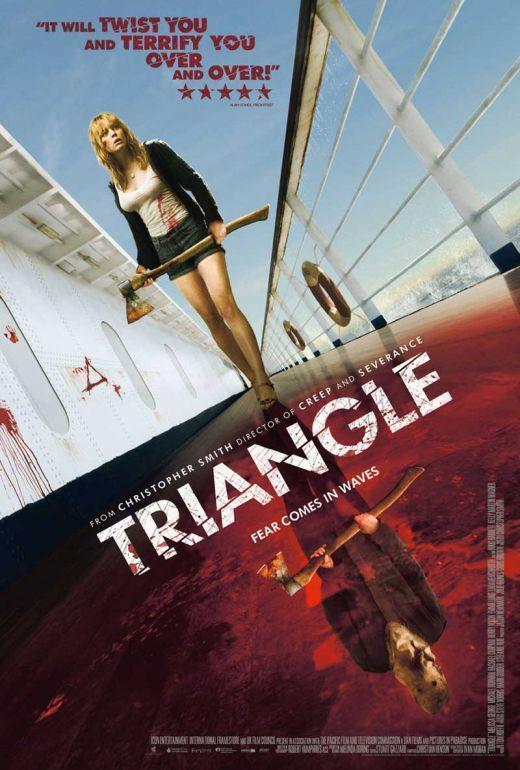
Triangle


Before I move into brief but SPOILER heavy territory, let me sum this up by saying: Triangle is a clever-as-hell premise that happens to a bunch of flat, uninteresting characters.

The Möbius nature of the story is concise, and as far as I can tell tight -- though the last half should have moved quicker, since we knew every beat by watching it already during the first half. (A very specific note: I wanted so bad for the film to cut to black when Jess says to the mysteriously cold-hearted and helpful cabdriver "Take me to the harbor." Why oh why did we have to watch the next ten minutes of tension-deflating recap?) The references throughout to Aeolus and Sisyphus were nice because, honestly, I didn't expect them to be so spot-on. I actually didn't see the thematic resonance coming, which is clever. But "clever," this movie has by the bucketful. What it lacks, as I mentioned above, is character.

Unfortunately, it's also a pretty blatant retelling of Timecrimes, another hyper-clever flat-character-inhabited story about closed loops and grandfather paradoxes. Where Timecrimes is straight head-scratching and mind-games, Triangle aims for horror, but it's only achieves "tense," never "scary," and even that lasts a mere thirty minutes before giving way back to the head-scratching and mind-games of its forefather. I've got to give some credit to Triangle though, for taking its ideas to their furthest conclusions, and continually one-upping its own premise to the very end. All that's nicely handled, with several reasonably creepy moments/ideas throughout. (The "pile of things leftover from the infinite loop" trope never felt old, and topped out for creep-factor in the deck full of brutalized, dead Sallys.) If only anybody in the movie had reacted to any of the clever mess in believable ways, or if only they could speak like humans speak. For me what kept me from loving an obviously smart script was its cardboard, throwaway characterizations and forced, artificial-sounding dialogue.

Not terrible, though. Just, alas, not very scary. And despite the ratcheted-up ideas and dark imagery, I think I like Timecrimes a little more not despite but because of its simplicity.

Trivia of note: Jess was played by Melissa George, whom I failed to recognize despite playing the real Camilla Rhodes in Mulholland Dr.

17 April 2010

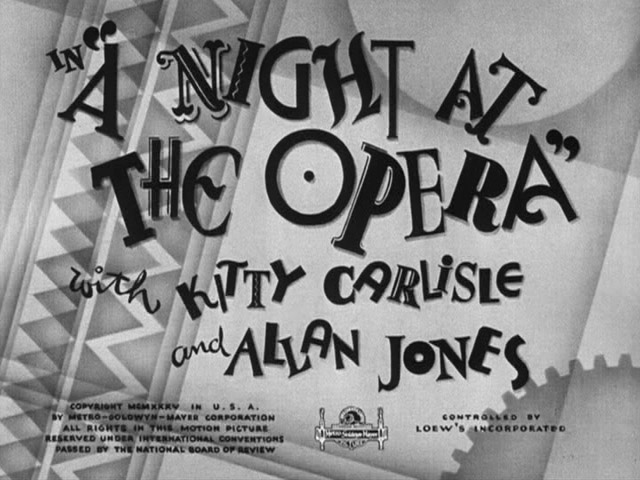
A Night at the Opera


It's really hard to say anything profound about a Marx Brothers film. They don't hold up to scrutiny; they weren't made for that. But they're endless fun. It's amazing how there's basically only one plot, how Groucho, Harpo, Chico and Zeppo (who's not in this one, admittedly) play the same roles every time, and yet it never gets tiresome. Harpo's a brilliant clown/mime (and a whiz on a harp), Chico plays a hilarious (Italian) liar/cheat, and Groucho is the charmingest lech and one-line backhander ever. I'll be honest with you, both were funny, but this film is overall a lot stronger and funnier than Horse Feathers.

My plan was actually to put on Hannah and Her Sisters, since after Horse Feathers I was reminded of the scene where the Marx Brothers (Duck Soup, but who's counting) reminds Woody Allen that life is worth living. Thing is, the disc wasn't working, so I went back for another Marx Brothers. To remind myself, as it were. I admit it seems like a cheat to just post a long quote in here and call it my blog entry, but how could I ever top this:

And I went upstairs to the balcony, and I sat down, and the movie was a film that I'd seen many times in my life since I was a kid, and I always loved it. I'm watching these people up on the screen and I started getting hooked on the film. I started to feel, how can you even think of killing yourself, I mean isn't it so stupid. Look at all the people up there on the screen, they're real funny, and what if the worst is true. What if there is no God and you only go around once and that's it. Well, ya know, don't you wanna be part of the experience? You know, what the hell, it's not all a drag. And I'm thinking to myself, Jeez, I should stop ruining my life searching for answers I'm never gonna get, and just enjoy it while it lasts. And after all, who knows, I mean maybe there is something. Nobody really knows. I know maybe is a very slim reed to hang your whole life on, but that's the best we have. And then I started to sit back, and I actually began to enjoy myself.

Woody Allen has summed up for me something profound about why the Marx Brothers are still fucking amazing, 75 years later. There's no way I was going to put it better.