Showing posts with label w. Show all posts

26 December 2010

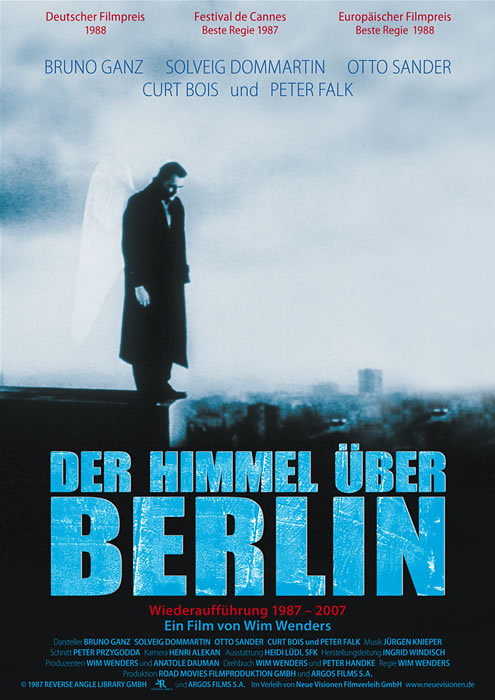
Der Himmel über Berlin (Wings of Desire)


Of course I like this movie. It's such a poetically humanistic movie, relishing in the small pleasures and tiny magical moments of being alive and human. It's not the first time theology or literature has suggested that angels live in awe and envy of mankind (if memory serves, Neil Gaiman's short story "Murder Mysteries" is one of my favorite explorations of this theme), but here it's done so viscerally and with such straightforward simplicity that you aren't simply told that angels envy us, you're shown how and why. At a remove, the angels aren't burdened with the distractions of being human and see the beauty of it instead, tiny inexplicable moments like a woman closing her umbrella in the rain and allowing herself to get soaked, that the angels here call "spiritual moments." This is a cinematic poem to what's so great about being alive.

It's also a story about being "at a remove" from life, of the importance and value in being more than just an observer of human nature, and getting your hands dirty in the muck and mess of it all. It's not nearly enough to sit back and watch, appreciate, admire, ponder; in Wings of Desire the pleasure of cold hands, smoking and coffee, or kicking up sand outweighs the most poetic thought or seemingly transcendent observation. All art falls victim to this distancing, and is therefore inferior to mere life, to mere living, even to suffering or distraction. It's a lesson I fight with every day myself, to be honest, and so again: of course I love this movie.

There's not much I can say about it, only because there's so many little things I'd love to say about it. Its use of color, light, performance and photography are all brilliant, intricate, and stunning. The editing especially carries the story as we cut from disparate scene to disparate scene or even intercut an unrelated but beautiful image into a moment. When Marion delivers her monologue at the end to Damiel in the same tone and rhythm as the onslaught of inner voices we've heard throughout, we know that what she is saying carries the weight and vulnerability of truth; she is revealing herself completely in this moment, speaking the language of the secret inner self. The interjections to Cassiel, to Peter Falk (!), to Homer lamenting a changed world, are all profound and perfect counterpoints to the main story of Damiel's fall (and his fall for Marion, so to speak).

The movie always stays with me in a million ways, leaving me wondering about life, the universe, and everything, but this time I'm also left with a strange thought: [SPOILER] if Peter Falk fell from grace as an angel twenty or thirty years ago, then who is the grandmother he is thinking about when wandering the wrecked plaza and seeing "the station where all the stations end"?

11 December 2010

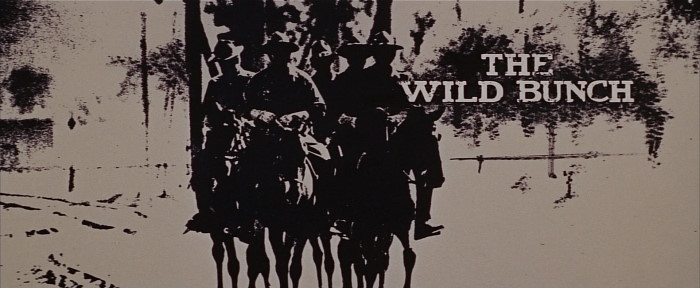
The Wild Bunch


I watched this back-to-back as a western double feature with a screener of the Coens' True Grit, and that may have colored my approach here. They certainly have a lot in common. (And full disclosure: I've seen the first half of this several times, but this was the first time that circumstances have allowed me to view the film in its entirety.) Of course the big deal about this film is its depiction of violence as visceral and gruesome, and impactful on the world of the story, not just there to titillate or excite you. Children fill the edges of almost every fight scene, witnessing, sometimes in shock, sometimes in joy and awe. Innocents are mowed down by the law enforcement men (the railroad agents and their hired guns; the junta military) and only mourned by the titular band of robbers, who seem to understand a tacit "soldiers-vs-civilians" attitude toward killing that nobody else does -- though even that is thrown out the window more than once in the story, as violence has a tendency to spread like wildfire and rarely ends well.

There's also of course the same bleak tone at the ending as True Grit, though here much more pronounced and poignant: nearly everyone we are led to care about dies at the end of the film in what is sort of like a hero's massacre and also sort of like a poorly thought out, hollowly pyrrhic victory.

...I'm going to be honest with you here. I wrote a lot more about the bleak ending. Then I wrote a whole long thing about the constant raucous laughter throughout, about how they "party hard," comparing the Wild Bunch gang to vikings and conquistadors. I commented about how they are always laughing at someone else's (one of their own's) misfortune or humiliation. I said all sorts of clever things about how the other characters in the story lacked the moral core that our anti-heroes had. But Safari logged me out of blogspot without warning me, and when I went to hit "post," it was all lost. No amount of hitting "back" resurrected all my work, and I don't feel like doing it all again. (What you're looking at here is the last draft before it fucked me. Thanks, Safari.)

And then I ended with the following, which I had saved in my copy/paste clipboard:

It's a little overlong and meanders in the middle, and it hits a lot of the same notes repeatedly -- which worked, but also wore on me. So while it's not my favorite Pekinpah film (maybe Bring Me The Head Of Alfredo Garcia?) or my favorite "revisionist western" (maybe McCabe & Mrs. Miller, or The Good, The Bad, and The Ugly, if that counts? or an Eastwood like Pale Rider, Unforgiven or Josey Wales), it's still undeniably a great film, and I'm really glad I finally saw it all the way through.

12 July 2010

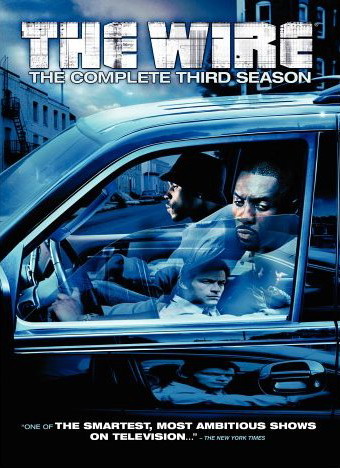
The Wire (season 3)


Man, there's so much closure at the end of this season I almost don't want two more years... Season 1 felt a little like that. Season 2 definitely didn't, not in a meaningful way. I guess if Season 2 was there to show that each season could be a different case, a different set of problems within the same universe, then Season 3 is there to expand to higher levels of the hierarchy and at the same time, wrap up all those Season 1/Season 2 loose ends. A short and probably incomplete list of characters whose arcs came to a reasonable (or definitive) close at the end of the third season include major characters like Stringer Bell, Avon, Omar, McNulty, Daniels, Bunny Colvin, Commissioner Burrell, and Bubs, not to mention smaller players like Johnny, Brother Mouzone, Calcetti (or whoever; the white boy running for office, whose story is just starting but you could call this the competent wrapping up of that chapter if you had to), the boxing coach whose name escapes me now, and arguably even Bodie and Poot (the smallfry that used to run with D'Angelo). That's a hefty list of threads wrapped up. I guess Kima, Freamon, Carv, Herc, Prez, Beadie and Bunk all left without a strong wrap-up everything's-changed "closure" moment, but none of them (maybe Prez... and I guess you could make a case for Kima) feel like they have unfinished business ahead of them. (Yeah, I'm good with character names. So sue me.)

So I guess, knowing there's two years left, I'm looking forward to exactly what I was looking forward to from Season 2, which is an entirely new chapter in an even bigger and broader arena, and seeing how the threads and new beginnings from Season 3 play out as we move into Season 4. What I'm dreading is what I was quietly dreading after Season 2, which is the mostly-well-done-but-still-necessary-and-obvious shoehorn work to get all the players, spread out to the wind, back together again, "The Whole Gang Rounded Up For A New Adventure," which the show seems deadset to do fresh every season. I guess that's how policework goes, from case to case, but from a dramatic standpoint the first couple of episodes always feel like reshuffling playing cards and then explaining why I've got the same hand as last time, or damn close to.

Anyway, so far my verdict is obviously glowingly positive -- I'm definitely a lover of The Wire -- but I may have to take a controversial stance and say that, so far, though it'd fall in my top ten TV drama series, probably top five, it wouldn't be my #1 spot. So far it hasn't dethroned Deadwood, and though it's clearly, clearly a smarter and richer show, highbrow and all that, it's not quite as guilty-pleasure fun as Lost. But hey, it's got two years (thirty hours, give or take!) of story left, and that's plenty of time to sway my opinion, so I'm hopefully optimistic and staying open to the possibility of changing my position drastically. Here's hoping.

And I still love Omar best of all. As far as non-key players, it's all Omar and Bubs for my money.

09 July 2010

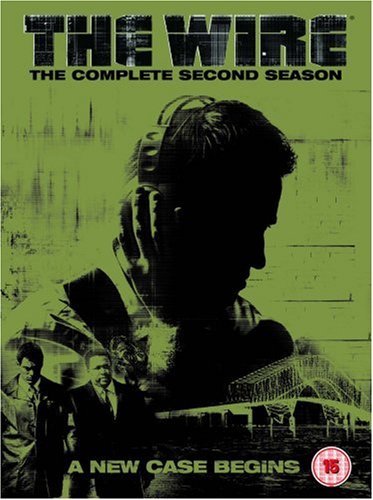
The Wire (season 2)


A couple of my friends, if memory serves, call the second season the best season of the best TV show in the history of both seasons and TV shows. I'm not really willing to go that far with it, but it's pretty fuckin' good.

Seems like all I ever do with this blog is come on here and answer a quick checklist -- does the story advance through character? does the story have a unifying theme that is explored smartly? is the structure smartly put together without feeling inorganic? and so forth. I usually write down thoughts in a bit of a hurry, more interested in whatever the next thing I'm going to watch is, or else I'm writing hours after the fact if I wasn't near something to write with when I saw the thing in question. So instead of delving into any kind of clearly thought out, brilliantly written and researched piece on any of the films I watch, I revert back to checklist, answer yes or no, use a lot of adjectives, say what I like or what I would have done differently, and then leave it as such. Well, hell, I guess I'm going to do it again, aren't I? (It's my blog, after all.)

Compared to Season 1, the plot here seemed driven by an awful lot of coincidences and cases of very lucky (or very unlucky) timing. For something so procedural, so detail-oriented and plot-driven, I can't lie: that's a little dissatisfying. The first half of the season has our heroes split apart, each working unrelated cases, each getting lucky with clues, and it all dovetails into a single case in a way that just smacks of television writing. Maybe I'm remembering it wrong, but Season 1 never felt like that to me. From the get-go it was more focused on D'Angelo Barksdale, and anything that came into the case was icing on that cake. Season 2's D'Angelo was Frank Sobotka, and the number of things that all happened at once to draw attention to him, the Greeks, the stevedores' union, and the drug and human (and fenced goods) trafficking were too numerous to get into. It was all over the place, and things wrapped into a single package too neatly for my money, even if the show's smart enough not to wrap up all the plotlines and criminal cases nearly as neatly. The second half of the season, once the story had legs, was for the most part smoother -- though not without an awful lot of coincidences on both sides of the fence. Maybe that's part of it, maybe there's a theme here that so much of investigative work is luck -- I'd buy that, but when it keeps happening and nobody seems to become aware of how lucky they are or how many coincidences factor into the investigation, it still ends up looking an awful lot like -- dare I say it -- kind of sloppy plotting, maybe even lazy writing.

Now, in defense of Season 2, the characters and the themes from the first season are expanded on here nicely. The villains from last season evolve and splinter in complicated and interesting ways. The new villains come in the same two flavors we remember from last year, giving us variations on a theme: they are either cold businessmen with the triumph of will on their side, or they are desperate, cornered people with moral centers bent and twisted by years of self-rationalization and a lack of good options. In other words, they are either "evil" out of greed and self-preservation, or they are "good" and believe that the sins they commit are in aide of something better than themselves (family, unions, community, love). Naturally its this second category that makes the show special, as intricate and three-dimensional relationships develop around and between intricate and three-dimensional players. How bent can your moral compass be? The Wire suggests to us that the answer is pretty damn bent, and since I'm inclined to agree I find that part of the show pretty brilliant. So while the plot feels all around more contrived this season, the characters were at least as fun to spend time with, if not more so.

I'll take a couple of days off, if I have the willpower, and let this one settle before I jump into Season 3, about which I know even less than I did about Season 2. Though it looks like Daniels got his detail permanent, and the merging of Proposition Joe and Stringer/Avon's powers is going to bring the action back into the drug trade in the towers. It'll be interesting to see which seeds from this season continue to grow and evolve into the next, if any -- and I'm hoping some do. Now that I'm two years into this and getting a feel for the way it moves, I don't want any season to feel like it exists within a vacuum. It needs to keep rippling forward, with characters moving in the background (and eventually back into the foreground) of each year's "new" storyline or investigation. After all, it's the Russian Novel of TV shows, right?

One last thing: I love the shit out of Omar. He's such a fearless wildcard free-agent character, just a ball of rage and barely concealed hurt, but he's also the closest thing the "bad guy" players have to a noir anti-hero, a man who transgresses all moral codes except his own. He's one part Robin Hood, one part Holy Avenger, one part Tormented Lover. And nothing scares that motherfucker. And all for a fallen boyfriend, which only adds another interesting layer to this laser-focused character. Where else is there a broken killer of a man who's an openly gay black thug? I love it. More Omar! Thanks.

05 July 2010

Winter's Bone *


Missouri Noir. Ozark Gothic. Are those things? They are now. I do like a good genre mashup, and one of my favorite types of stories is the noir detective story, which beneath all its layers of Ozarkian grime and poverty, this totally is. Plus it's got two Deadwood alumni, the fantastic John Hawkes and the creepy-chameleon Garrett Dillahunt. Plus it's got Laura Palmer, and Sheryl Lee still looks good, even in a sad messed-up warts-and-all role like this. Acting credit really has to go to Jennifer Lawrence the lead, though, who carries such a tough and uncommon role for an American film: the believably strong girl, the survivor. She walks the moral line just like a good detective must, skirting between the law and the lawless, remaining tenacious, tight-lipped and smart-mouthed.

One thing that struck me is how the narrative kind of got away from our protagonist at the end, how the further into the story we go the more we realize that not only are events unfolding over her head, but they're unfolding ahead of her and she's playing catch-up. By the climactic end, no punches are pulled for emotional involvement or intensity, but the events aren't caused by choices Ree makes; instead it's a series of events happening to her, or information brought to her. The thing is, none of this hurts the drama of the film or the primary brunt of this story. After all, this isn't a story of Ree reuniting with her father or coming to terms with his life and death; this isn't a tale of her revenge on those he got mixed up with. This is a smaller story: Ree staying afloat barely, keeping her family together, not succumbing to the shit she's swimming through. And it's goddamn tragic-beautiful from its first frame to its last.

Seen at the Regal Fox Tower.

22 June 2010

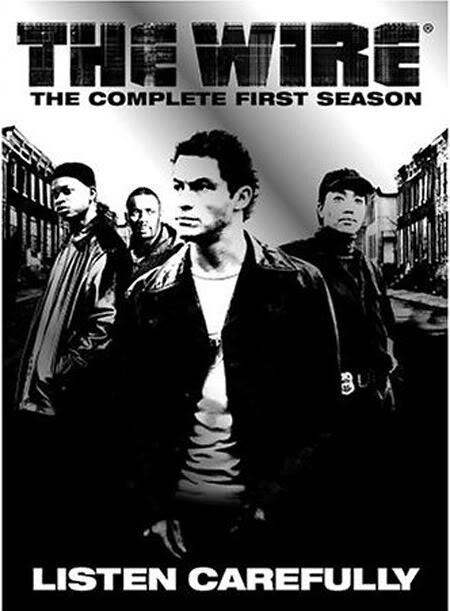
The Wire (season 1)


Boy, first watching of fifteen hours of story, it's hard to know what to say, but I ought to say something. (In retrospect, I missed the boat and should have said something about the last season of Lost as well.) People are right, it's involving and rich and tapestry-like, it's a Russian novel of a TV show about cops and crooks, and it's amazing.

Once before, years back, I watched roughly the first half of this season and lost steam (not the show's fault; sometimes life gets busy), and back then I remember thinking that the show just sort of moved naturalistically around these characters and locations with no real sharp focus or single motivating drive -- I meant all that in a good way, stressing the naturalism of the story. But this time it was amazing to see the gears work. Maybe I'm better at story now than I was then (this is undoubtedly true, actually), but it was interesting to see a master storyteller pulling strings, keeping the plot going where the plot needs to go, without ever losing sight of the most important thing: the characters. Everything stems from them, and whether it's some action that's mechanically necessary to advance the plot or whether it's just a small gesture that gloriously, unexpectedly blossoms into a major event down the road, it all comes out of who these people are and what they want.

Also, too, it's worth noting that like all the best TV shows, any single episode works as a concise pocket of storytelling, moving us through a crucial chapter in the big picture and also giving us those subplots and smaller moments, all linked together by themes and parallels. "Lessons" and "Cleaning Up" and "The Cost" become not just chapter-headings and episode titles but succinct ways of viewing the driving character forces and similarities between the good guys and the bad guys. Oh, it's good stuff.

Waiting a day or two to jump into season 2. Looking forward to it.

11 March 2010

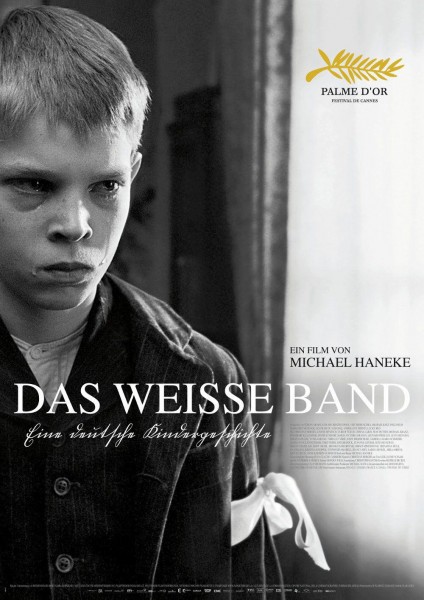
Das weiße Band (The White Ribbon) *


If I may be so bold: this film breaks two unspoken rules of western cinema. First, never have a voiceover sum up action that you could just as easily dramatize; and second, don't telegraph the solution to your mystery in the first five minutes of your two-plus hour film. The first one -- unfortunately, that's broken all the time (I'm looking at you, Avatar, and also you, Vicky Cristina Barcelona). The second and more egregious crime -- also occasionally broken, though thankfully a lot less often.

But here's the thing: Michael Haneke's way too much a master of cinema (watching something as austere and reserved and cinematic as this, you can't help but think of Bergman) to make these mistakes lightly. It's not lazy when Haneke does it. So what's he doing to us? Well, he's telling us who the killers are so we can instead look at the rest of the story and see how monsters are formed. I jokingly called this film The Biggest Jerk in Jerktown, and aside from just loving the title for its own sake (maybe one day I'll find a use for it) I think there's something to that. Cold, ruthless cruelty runs so deep in this German village that the moments of genuine warmth feel a little awkward and misplaced, maybe even suspect. You're just waiting for something terrible to befall the young lovers, or the cute kid with the bird.

The German title includes a subtitle, Eine deutsche Kindergeschichte, which Google tells me translates as "A German children's story." Take that how you will. Cynical in-joke? Challenge to your perspective? Unsubtle foreshadowing? Again, Haneke is a master: I'm going to say it's a little of each.

Seen at the Fox Tower.

27 February 2010

Star Trek II: The Wrath of Khan


It's interesting to note that Nicholas Meyer was completely unfamiliar with the series when he wrote and directed this game-changer, just like Abrams with the new Star Trek. And on an even geekier note, it's impossible for me to watch this without seeing how influential it was on the world of Star Trek, in building a franchise out of a series (as I argued previously). All from a guy who hadn't even seen the show. This is the first part in a trilogy about the death and rebirth of Spock (and Kirk, and inversely the Enterprise), and when the closing chapter of the trilogy came out, so too did The Next Generation, and Star Trek was officially a franchise nerds would forever consider in direct competition with Star Wars. (It's a good paradigm: Wars represents space-opera or fantasy; Trek represents a somewhat harder, concept-driven science fiction.)

The movie is about age, aging, dying, and feeling useful. Nicholas Meyer is obsessed with Sherlock Holmes and compared Kirk to Holmes: Holmes without his cases becomes half a man; Kirk without his starship likewise. Anyway, it's a brave and good choice for Shatner, famously vain, to portray a man fearing his own age. Even so, I have to point out: William Shatner was 51 when this was made, and he looks amazing. I honestly would have believed you if you told me he was 40, perhaps even late thirties.

Two quick final thoughts: One, I recently saw Krull again, where James Horner recycles his gorgeous score pretty much piecemeal, and it's tainted the soundtrack for me with images of flying horses, solemn cyclops, and really bad acting. And two, Spock's death and Kirk's eulogy both still kind of get to me. They're great scenes. Easily one of the best screen deaths I can think of.

10 January 2010

砂の女 (Suna no onna / Woman In The Dunes)


I'm a huge fan of the Abe/Teshigahara collaborations. This one's the sexy one, but it's actually a little mopey, very creepy and thought-provoking. Which is, actually, exactly how I like my sexy. Ask anyone. (Well, okay, you can go light on the creepy.)