Showing posts with label g. Show all posts

27 June 2011

Godfather, Part II


Of course I want to talk about this one for hours, but I can't and won't. I've only seen Par II once or twice ever, and the most recent was more than five years ago, so I got to come at it with reasonably fresh eyes. And I'm sorry, hardcore fans, but The Godfather (Part I) is an undeniably better film. It's a matter of bias (though what do you expect?), but the first film has a sharp focus, a single journey for an entire family, a sense of larger-than-life tragedy as many lose their lives and others lose their souls to grander causes.

Part II seems in every way the best-case scenario "smart sequel." It expands the world by showing us what happens next (and what came before), and it deepens the existing themes and crises as it goes. But apart from some really strong drama and really smart filmmaking, I'm not sure it says a whole lot more about the themes or crises than the first film said. Kay's crisis (which really represents Michael's sacrifice of his humanity and compassion) is more forefront, and the drama of what she goes through is darker throughout, but it never felt surprising or revealing in any way beyond the expected. Michael's relationships with Tom Hagen and Fredo are similar: they expand in scope and develop as plot points, but they are built from the same basic building blocks that shaped the relationships of the first movie. Tom is more at ease with his position, though he shows several times an emotional sensitivity to being shut out or misused; Fredo is less at ease with his, having now been more formally overstepped by his little brother, but he is basically the same well-meaning, weak-willed, marginally incompetent tragic character he was in the first story. There he never betrays the family directly, but he seems to insult them by betraying their philosophies and way of life (when he gets in with Moe Green); here he betrays them more directly (in scenes we are tragically never witness to, but then again it's not Fredo's story) but only because his wounded pride and desperate need for respect (mostly self-respect, but also the respect of his brothers and peers) are manipulated. It all works, and it tells a really good story that deserves the kind of respect it got, but it's a more fragmented continuation of Part I.

Actually, to put that another way and give it a little more credit: it's the kind of rich, robust, true-to-the-original-themes storytelling that we see more now, in serialized television than we saw then, in feature films. I'm sure it was no coincidence that this film doesn't bear any title other than the original's, it is merely Part II, not Part II: Michael's Mafioso Adventures or whatever. This is simply a continuation. It could be viewed best (and perhaps only) as the same story, not a new one.

One last thought I'll keep brief: I thought the Vito backstory was beautiful, and well-performed, and pretty well-written, but it always felt a little like Vito telling his own story. He was always just a little too noble, a little too beyond reproach in his actions. I'm not sure he shows a single weakness in any scene, and he never makes a misstep or mistake, never loses a thing in his journey. It was nice to see the rise of the man (and Empire), but it almost seemed a little too Yin and Yang, with Michael's consistently tragic (and surprisingly messy) story.

I want to go on, but other matters demand my attention tonight.

09 March 2011

The Godfather


Now here's a nice continuation of tonight's theme of crime melodramas. Shockproof was (ostensibly) about a morally upright man driven to the dark side by love of a woman; As Tears Go By was about an amoral man tempted toward the light side by love of a woman, but ultimately brought down by brotherly love for a fellow gangster; and here, The Godfather is about a shrewd, smart man born into amorality who tries (twice) to let the love of a woman keep him from slipping, but ultimately his responsibility to and love of his family draws him back down.

In a way it's always been odd to me that Brando is all over the posters and movie boxes for this. I mean, literally speaking he's the title character, but the story is really about Michael Corleone's transition from golden boy/war hero into the next Don/Godfather. It's the story about the position or role of "Godfather" and its power, and the gradual but inevitable transition from too-smart-to-get-involved Michael into cold, shrewd, too-smart-to-do-anything-else Michael. Of course, it's also about the family and the role of family and about the transition from one generation's way of thinking into the next and how the departing seat's values ought to be respected but considered skeptically by those coming into power, and about the nature of (and right time and place for, and right time and place to avoid) violence, and the value of firm action over mere words (this at least is something I could easily argue is echoed throughout As Tears Go By and is perversely, poignantly missing from Shockproof). But I always look to drama and character first, and the story isn't Vito's, it's Michael's. Part II splits its focus between the two, to both the benefit and detriment of the film if you ask me, but Part I here is strictly Michael's story.

I'm not actually making a case against Brando being on the posters, of course. Brando is the big-deal actor, and the iconic figure of the story. It's Michael who's the classic hero here, who resists and then answers the call to action, who faces demons in a cave, sets sail for distant lands, usurps his father's throne and returns home a changed man, but it's Vito Corleone casting the looming shadow over everything: Vito is at various points nemesis, trickster, attractor and mentor. He's the key to everything. Of course he's on the poster.

But the story belongs solely to Michael Corleone, is all I'm saying.

16 February 2011

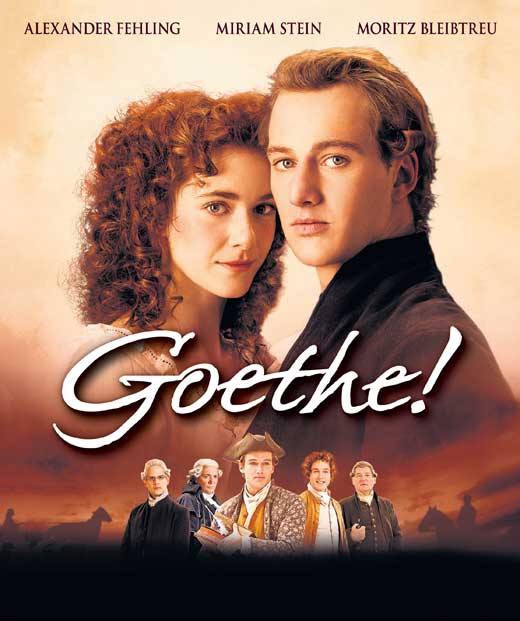
Goethe! (Young Goethe in Love) *


I have always wished I knew more about Goethe and The Sorrows of Young Werther. It's always been a bit of a blind spot. All I knew, really, about Young Werther was that it's about how being young and heartbroken sucks and is supposedly responsible for more suicides than any other single work in the history of western literature. All I knew about Goethe was that Germany considered him their own personal Shakespeare and he was kind of a big deal. (Full disclosure: I completely forgot he was responsible for Faust, though halfway through this film I had my hunches.) So I was not in the ideal position to watch a film overflowing with nods to his most famous work -- though I seemed to be in a better position than the vocal minority of housewives and silver hairs who surrounded us in the theater.

For the most part, I liked it. Bits of it clung too easily to the hoariest of romance film formulas, but Wikipedia suggests that those things were true to the texts, which suggests to me that some of those hoary formulas may owe a debt to this, or at least to literature from this era. Reading how Young Werther is an amalgamation of Goethe's life, his friend Jerusalem's, and his fantasy version of events with Charlotte Buff, it's fitting to find a different configuration of these elements come alive in the film. In fact, reading just the summary on Wikipedia gives me already a newfound respect for both the film and its drama.

My one nagging thought, then, concerns the end. Young Werther did reportedly turn Goethe into an overnight sensation and celebrity, as was dramatized in the film, and that in itself felt sudden but didn't bother me. I enjoy that he leaves the work to Lotte and demands she burn it, but her final gift to him ("We cannot be together in truth, but we will always be together in poetry," she tells him) is the publication of his longing for her and the pain he's endured. It's a beautiful love letter outside the confines of actuality, wherein Lotte remains with the stable, mostly decent Albert. Even the reversal of Goethe's father from frustration to pride is perfectly fine with me (because even though he disdains all that "scribbling," he really only wants what's best for the boy, which in his mind is success -- not necessarily law).

What sticks out like a sore thumb about the end is Goethe's own reaction to all this. He seems overjoyed, bubbling with glee, without a care in the world. I wanted this ending, where his lost love is both literally and figuratively what gives him the recognition for the only other thing he's ever loved, to be bittersweet. He got what he wanted by losing what he wanted, and his heart suffered terribly for what he gained. Showing him let go of all that with such ease, shrugging off the inconvenient weight of all that "Sorrow" so readily, devalues the journey he's gone through and the loss he's borne. It twists the rest of the story, for me, in an awkward direction, where love and longing and loss become palatable experiences if artistic success can be gleaned from them. And while I may even, on some level, agree with that sentiment, to deny the sacrifice for the goal seems to happily render the sacrifice null, or close to.

So yeah, that ending (and his reaction to the story's conclusion) feels a little too 80s comedy for me. I half-expected Goethe to leap upward and freeze-frame in mid-air, knees bent, arms out, laughing hysterically with his buddies. But everything up until that point was really nicely handled, and much richer once I've done even the barest research into the story behind the story. Call it one more book I'd like one day to read, but who knows. As I've said, it's a depressingly long list.

Seen at the Broadway Metroplex, as part of the Portland International Festival.

13 February 2011

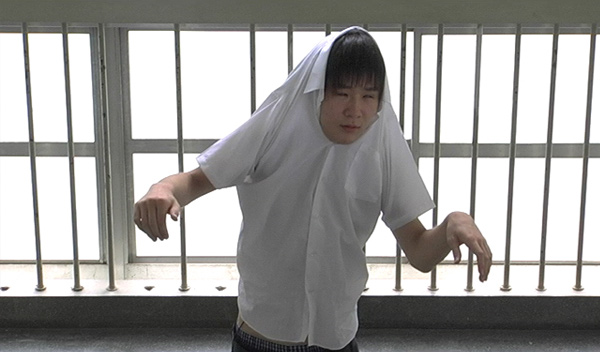
世界グッドモーニング!! (Good Morning to the World!) *


Before I get into this, I need to say: unfortunately, the version that the Portland International Film Festival is showing of this has some egregious, prohibitively distracting problems with its interlacing. Maybe every copy that went out looks like this, I don't know -- but it's definitely a fixable error. Specifically, I'm pretty sure it's a shift-field issue, and the truth is it tainted the experience of watching what was already an extreme-low-budget Japanese film that appears to have been shot on a ten-year-old DV camera. And so:

It depends on how you want to view this. Is it a deconstructionist anti-narrative, with one part coming-of-age road movie and one-part inside-out detective story? Or is it an amateur's meandering story with no center and no linear direction? Either way, along the way are some interesting parts and some clearly padded-out-for-no-reason parts, but it's difficult for me to say if the intent here is artsy and high-brow or simplistic and low-brow.

The film starts strong, with a kind of high-schooler version of Mersault accidentally causing (or having nothing to do with) a homeless man's death and getting his classmate in trouble with a strict teacher, resulting in enough social pressure to practically force him to skip class. All that's interesting, as pieces start to crumble and pressures start to build all around this stoic, sheltered, lonely boy. And as he begins a journey to return the bag he's stolen, or at least do some right by the man who died and inform his loved ones, the story should have become more engaging as his focus sharpened and the trail of chaos broadened, but those things don't happen. Instead we get a lifeless series of vignettes, what looks like an episodic trek through the rural outskirts of Japan in a film that might have cost as little as $200 to shoot (depending on how much hot air balloon rentals run).

So basically, it starts with dull promise and collapses quickly. But I have read this is a first (?) film by a 23-year-old student, and while it doesn't save the film to know this, I'd say this shows promise both in understated storytelling and economical filmmaking. I'd be interested to see future works by Satoru Hirohara, but I don't think there's enough in Good Morning to the World to revisit it, or to recommend it to others.

And Jen absolutely hated it.

Seen at the Broadway Metroplex as part of the Portland International Film Festival.

29 January 2011

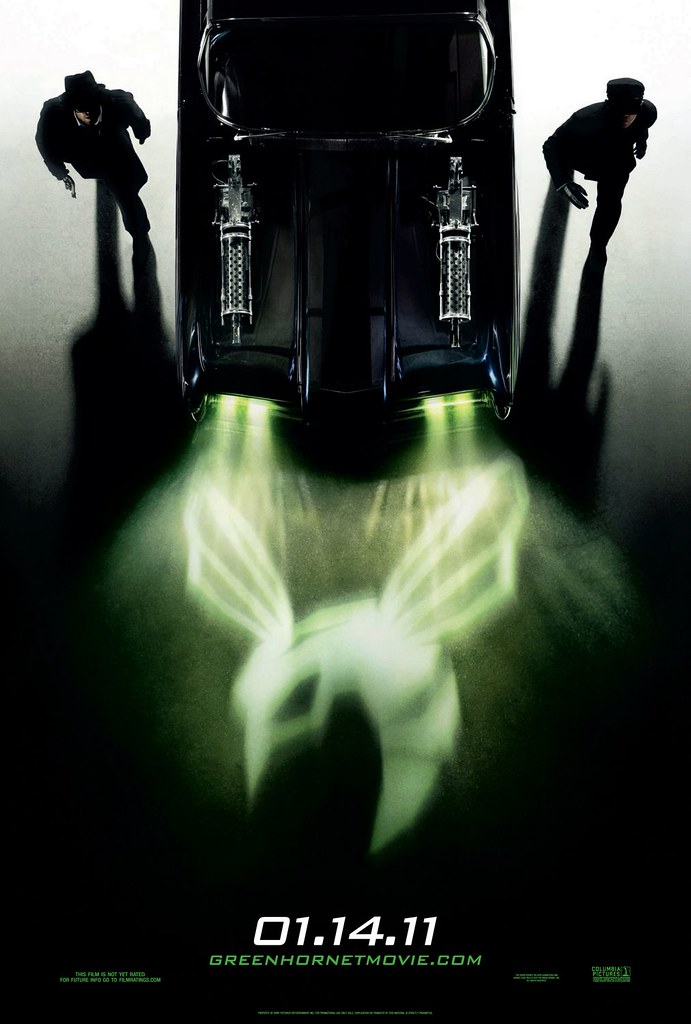
The Green Hornet *


This is a lousy movie. There's just nothing else to say about it. Seth Rogan wrote a lousy movie. Michel Gondry directed a lousy movie. I am shocked at how bad it was, and I would have walked out of the theater had I been seeing it alone (and I never do that -- in fact I've never done it). Rogan's Britt Reid is an unrepentant dickhole who lives in a world of bro-tastic bro-ness, complete with debilitatingly intense gay panic and that weird, acerbic camaraderie entrenched in an ugly loathing for oneself and everyone else in roughly equal measure. It is styleless, toothless, and feckless. Rogan and Jay Chou have zero chemistry. Diaz, Waltz, Wilkinson, and EJO all play thankless, meaningless roles -- more like props than characters, in fact. And I haven't seen this many nutshots in a single movie... ever.

Funny enough I didn't hate it, but almost. I went in expecting it to be bad and it was at least as bad as I'd expected. I have nothing invested in the idea of a good Green Hornet story, though I'm aware enough of the original to see how shoehorning in a frat-boy trustafarian douchebag and a lot of "dude don't be so gay" jokes is egregiously off-key. There were almost no spots that worked, and even less that made the remotest bit of sense. Most of the Gondryisms were half-assed and felt like afterthoughts to a story that didn't call for any -- the only one I even enjoyed was the screen-splitting montage of word-of-mouth, but it was pretty unmotivated and too deaden to be whimsical -- and honestly? That's just an expansion on an effect he'd pretty much already mastered 13 years ago.

The editing, too, deserves a special note for how pointedly lazy it is with the story: a newsroom scene has a bunch of reporters rattle off a list of offenses the Green Hornet has been seen doing over the past few days, which is followed by (not preceded by) a rock-n-roll montage of them doing all those things -- most obviously, shooting out a stoplight-camera. I imagine they decided the scenes worked better in the opposite order, but anyone actually paying the tiniest bit of attention to dialogue would find it a little suspicious that the Hornet seems surprised by the ability to shoot out a stoplight-camera if they'd just done so last night as well. I'm not convinced anyone cared.

I hate to say this -- then again, it's also not the first time I've said it -- Michel Gondry is not a brilliant director without a brilliant script to interpret, and one that calls for his particular skills. This film is neither of those things, even a little bit. Science of Sleep and Be Kind Rewind both play as sloppy messes as films, but as passable entertainment as delivery systems for Gondryesque moments. Human Nature is decent, and of course Eternal Sunshine is a truly gorgeous perfect-storm of talent and style, but The Green Hornet should have been a McG project that nobody paid any attention to or something. At best it might have been doctored and worked into a good movie by David Gordon Green or Jody Hill, maybe. But there's nothing for Gondry here. And Seth Rogan is at least as unlikable here as he is anywhere. This film is... yuck. It's just lousy.

Seen at the Regal Cinemas at Lancaster Mall.

18 October 2010

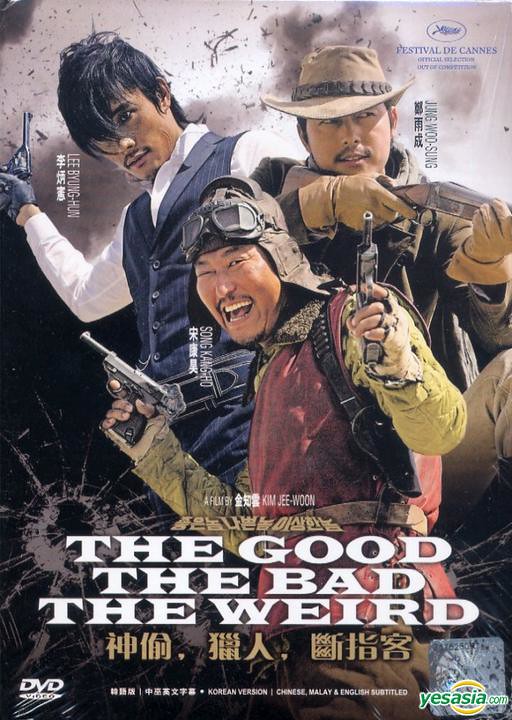
좋은 놈, 나쁜 놈, 이상한 놈 (Joheun nom nabbeun nom isanghan nom / The Good The Bad The Weird)


I'm actually glad I just watched Leone's full trilogy before this, because although the characters are pretty clearly (though pretty loosely) based on the titular Good, Bad, and Ugly, scenes are stolen/homaged out of Fistful of Dollars and For a Few Dollars More as well. For most of the film, it felt more like the title should have been "The Good, The Bad, The Weird, The Gang, The Other Gang, and the Japanese Army." So many forces were chasing after this one map it got a little Mad, Mad, Mad World-esque. In fact, they play pretty loose with how each group keeps its eyes on the prize, and you just sort of accepted that in this cartoony world the three title characters/heroes were unkillable no matter what happened (the same is true in an Indiana Jones movie; I think this may differentiate action films from action-adventure, and I don't mean this as a complaint). The story is all an action-set-piece delivery system, and it doesn't disappoint in that regard.

The epic chase across the endless desert at the end was ridiculous and fun, and summed up the whole movie perfectly. It was largely impossible to tell who is doing what, exactly, or who is who's main antagonist, but Yoon Tae-goo (the Weird) has the map and is always somehow in the lead. Park Chang-yi (the Bad) looks like Vampire The Masquerade (Jen called it; she's right) and gets hilariously petulant when something gets in his way. And Park Do-won (the Good) is kind of a pretty-boy Korean Clint Eastwood, who apparently just wants to kill this mysterious guy who killed five guys, even though everybody racks up death tolls in the double digits every time a gun is fired. I think I missed something. Anyway he's a bad-ass, too, and likes his rifle.

So it's a mess, but it's interesting to look at the weird culture mash-up on display, and it's entertaining as hell. The only reason the story doesn't collapse under its own circuitous, convoluted weight (mixaphorically speaking) is the same reason that last mega-chase scene worked: it never slows down, and everybody just keeps barreling ahead at a breakneck pace. So long as everything's in motion, you don't have time to stop and think, and the ride stays fun.

10 October 2010

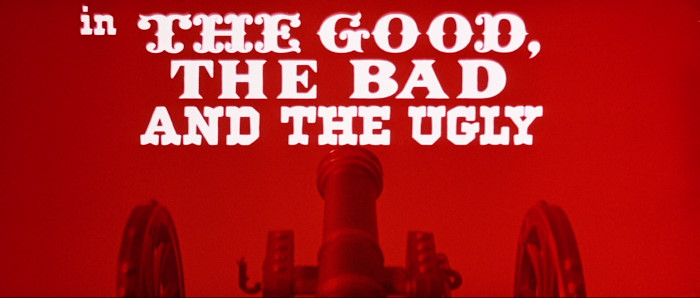
Il buono, il brutto, il cattivo (The Good, the Bad and the Ugly)


Okay, I lied. This truly is the best of the trilogy. With each film, Leone expands in all the right ways. For one, the budget goes up considerably, as does the polish and production value; but more than that, the characters multiply and deepen, the world gets bigger, the plot more complicated (in an interesting way), and the themes become more nuanced. By the time we get to this, the most famous of the three, everything seems to be working together, a perfect storm of a film. The damn thing is three solid hours long, and although it feels it, you're never bored at all.

In fact, the three hours seem almost perfectly broken into equal-sized acts. The first hour is spent building the three characters, particularly the relationship between Blondie (the Good) and Tuco (the Ugly), with the ever-looming spectre of Angel Eyes (the Bad) homing in slowly on a load of money. At the one-hour mark, Blondie and Tuco stumble upon Bill Carson and each learn half the information needed to find the treasure. Act Two is spent bumbling through a mission, the confederates, the yankees, and eventually teaming up with Angel Eyes and his gang. At the two-hour mark, the showdown in the ghost town equalizes the three and sets them up for the final chase to the cemetery. Act Three is spent crossing the final thresholds and squaring off one-on-one-on-one in a fascinating if awfully convenient standoff to end all standoffs.

It's such a film about sides and shifting loyalties! You've got a constant backdrop of the end of the civil war, and the characters bounce between both sides, impersonating with little difficulty whichever side is likely to help their cause. Then you've got Blondie and Angel Eyes, explicitly demarcated for us as "Good" and "Bad" respectively, even though both are fairly underhanded throughout (but it's never ambiguous: Blondie is definitely the compassionate one, Angel Eyes the ice-cold murderer), and this obviously leaves Tuco, our Ugly, as the wildcard, the middle, the shifter. Tuco bounces easily between being as backstabbing and devious as Angel Eyes or as warm and amiable as Blondie (which, for this world, is remarkably warm and amiable, actually), and this has a double effect. First, it makes him the key to the whole story, because shifting allegiances and constantly choosing sides is what the story hinges on in so many ways. It also makes him the most interesting to watch, as he is the most dynamic, unpredictable character of the three. (Eli Wallach is really the star here, if you ask me, stealing every scene he's in.)

The climax of the film hinges on the fact that Tuco has more or less sided with Blondie throughout, that he was never really as bad as Bad, he never really allied with Angel Eyes after all, and since it was a pull for power between two (not three) sides, since this was a tug-of-war between Good and Bad, having Ugly side with Good tipped the scales. In a film all about shifting allegiances, it has to all come down to who the wildcard sides with.

The story deals so well with the absurdity of right and wrong, the brutal pointlessness of war, the fundamental lack of difference between "good" and "evil" as opposing forces, and the soul-wearying effect war has on a culture, not to mention comments on class, desperation, friendship, religion, family, and community as well. It's so rich. Too layered for me to do it justice here, that's for sure. I've heard somewhere or other that Leone's masterpiece is supposed to be Once Upon a Time in the West, but it's hard to imagine a film better than The Good, the Bad and the Ugly for revisionist 60s westerns (spaghetti or no). Then again, I said something similar about For A Few Dollars More pretty recently, so.

Only one way to find out.

23 July 2010

Män som hatar kvinnor / The Girl with the Dragon Tattoo *


Boy, it's telling that the original Swedish title of both the film and the source novel is Men Who Hate Women. I guess the more direct Sweden Is Rapeland just wouldn't have sold enough copies (or movie tickets), huh?

In short, this film is very good, a good ol' mystery story that turns fairly cleverly and pretty smoothly into a serial killer story, with a likable odd-couple as the intrepid detectives. More than one moment in the story felt almost unbearably tense, and the whole "scanning the internet or scouring old logbooks for clues" stuff was never as boring as it might have been. I genuinely liked both the protagonists and enjoyed their tense tete-â-tete, and if the film's final solutions (no Nazi pun intended) felt somewhat obvious from the get-go, the script doesn't punish you by beating you over the head with it. I get the impression they half expected you to beat the characters to the conclusions they come to, and that's okay. It's still about the drama of getting there.

I know this is a world-famous much-hyped novel series right now, and so I assume in all those extra pages they must explain the biggest nagging question the film left me with, which is why the hell did Lisbeth get involved in the case in the first place? She was hired to hack his stuff, she did that, she found him trustworthy, okay, but what drive does a girl this guarded and this dangerous (and borderline self-destructive) have to continue pursuing Mikael's remote-accessed laptop once she's delivered files to her bosses? Then to expose herself to him because she's answered a riddle he hasn't... I mean, I get that part of her just wanted to rub it in his face that she's smarter, but this is more. She puts herself out there like she never has before, and there's got to be some missing scene or chapter or pages that explains this huge bold move to us, right? Because once she's in, I am hooked right alongside her (and him), I can see why you wouldn't let up, but I can find no reason inside the story for her to cross that first threshold, and that really frustrates me.

And seriously, I think the ratio of Nazis, serial rapists, or Nazi-serial-rapist/serial-killers to nice guys in this movie is about 2:1 or maybe even 3:1. I enjoyed that Women Getting Revenge never overshadowed the interpersonal drama stuff or the main whodunnit plot, but there was a certain theme of Men Are Monsters here that felt, frankly, disappointingly one-sided. Never once were we given a deeper motive for any of the monstrosities against women except "it feels good." (SPOILER) The religious/Nazi thing was even dismissed by all but the dead father. Men simply do these things because those men are "evil," and that's less terrifying and more didactic than this film deserves.

I did, though, quite like some of the thematic repetitions throughout, like the unfortunate nature of a "photographic memory" and Lisbeth's inability to forget the minutest detail of the things she'd suffered through (echoed back to her as she videotapes her own brutal rape). And I enjoyed that Lisbeth was shown as still capable, in her own guarded way, of loving -- both physically and emotionally -- despite the trauma she'd suffered through. Often with rape-victim movies and especially with rape-victim movies where the rapists are depicted as un-nuanced forces of evil, the victim's suffering permeates every facet of their being in a way that leaves no room for character or color. Here it shades her, but she still feels like a developed and three-dimensional human being, and that goes a long way toward redeeming the story's flatness of the villains for me. In fact, I would have loved to spend more time in the conflicted and contradictory psychology of the title character, in light of where she's been, who she is now, and the kind of future Mikael's stability and quiet acceptance seems to be offering her. I found that more enthralling than the actual murder investigation, but then again like I said, it seemed clear to me from the get-go that Harriet was still alive -- and besides, I've always gone more for character than for plot, if push comes to shove.


Seen at the Laurelhurst Theater.

15 April 2010

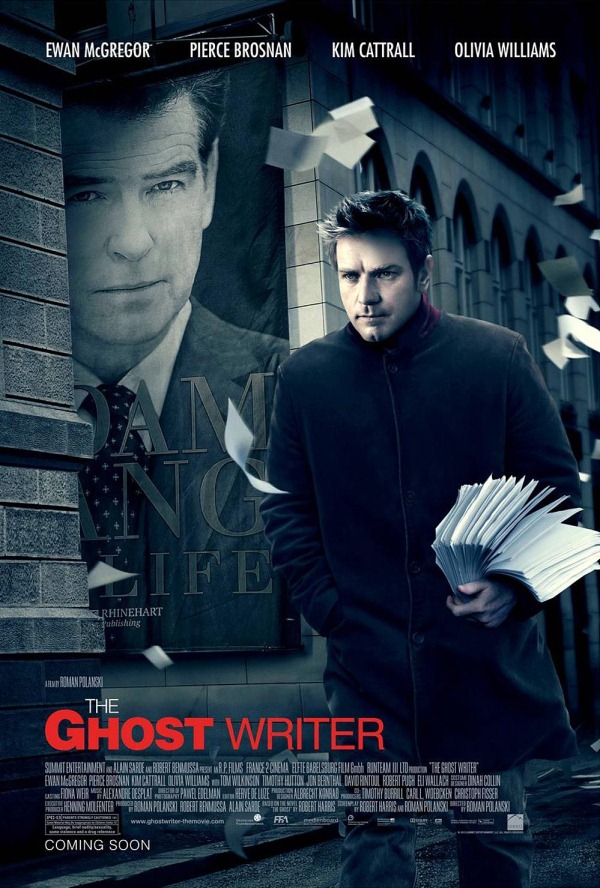
The Ghost Writer *


Look, I'm not a film critic. I'm not even a film scholar. I'm just a barely literate film fan, so I'm not obliged to look at a film from any specific or objective perspective (nobody is; but there is a misconception that critics and scholars are supposed to when "reviewing" something). The point is, I'm going to straight-up compare The Ghost Writer to Shutter Island, and there's nothing you can do about it.

I don't mean to make a thing of it. The two aren't in any kind of direct competition here. I only bring it up because both films seem to stand on the shoulders of a certain Mr. Hitchcock. Both have staged, rushed characterizations. Both rely on exposition and play fast and loose with motivation, focusing instead on action and image. Both are puzzle films, mysteries, psychological thrillers. Both are brilliantly shot and beautifully moody. Both had that air of filmmaking giants dabbling in pulp and homage. But only one was fun, engaging, made me laugh a couple of times, and still had surprises and twists worth waiting for. Only one felt like it had new things to say on old subjects (that may be harsh, but that's how it felt on a single viewing each). Only one of the two films worked as a movie, for this guy. And I'm sorry, Marty, but I'm giving the tiara to Roman here.

The characters are silly, through and through, but in that "right" way to be silly for the movie it is. Since I'm comparing, I can't call The Ghost Writer a labor of love without acknowledging Scorsese's as the same. Both these guys love the pulpy thriller genre, clearly. And thank you, guys, because so do I. But scenes in Polanski's -- well, you can't watch this film without the shadow of his years in exile and impending arrest hanging over it, and in the dim light of that shadow (er, that metaphor collapsed; sorry) you can really see the personal touches, the paranoia and desperation and frustration that has fed a man living the way PM Adam Lang has. It makes the story feel like it needs to be told, it makes the story (like most or all Polanski's stories) feel like a window into something. Maybe that's there in Scorsese's, but I didn't see it. For me Shutter Island was opaque and clunky. The Ghost Writer, by comparison, is breezy and graceful.

One more thing. There is something about this movie that I found unbearable, and that's the blatant foul-language scrubbing. It's the worst ADR'd "fuck" removals I've seen on the big screen. You could watch the lips say "fuck" all the time, but the voices say "shit" and "sod" and "asshole" and "balls." And they cut in so clumsily, often missing the "F"s -- three times I swear a character cursed by saying "fffit." It was awful, awful, awful, and I felt like I was watching the edited-for-television version. (For the record, I counted two "fucks" left in there, one a great big one and one a toss-off, maybe-not-worth-overdubbing one.) Was getting a PG-13 rating over language worth it for this film? Is a semi-political semi-psychological thriller about a writer and a Tony Blair stand-in the kind of thing fifteen year-olds are desperate to see? It almost ruined the film for me.

Anyway, other than that, I approve.

Seen at the Fox Tower.

29 March 2010

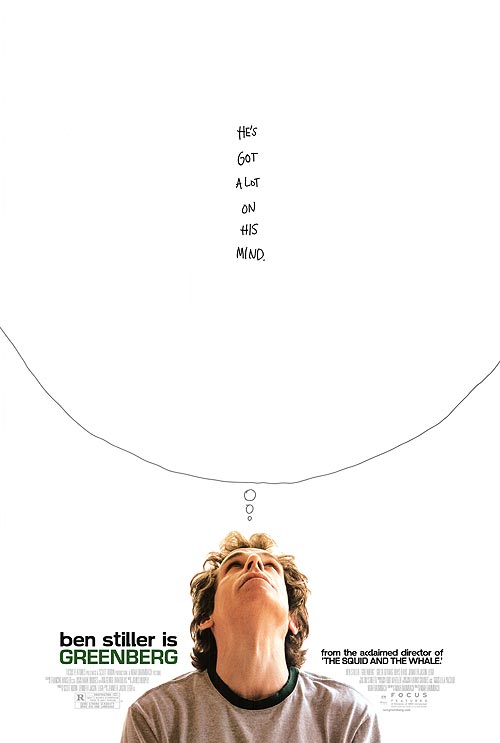
Greenberg *


When a movie is very good, it's (relatively) easy to take off the critic hat and just enjoy the movie. For me, however, it's not as easy to take off the writer hat. That's not always a bad thing; it is what it is. I just mention it because I'm returning to/beginning anew an absurdist black comedy with some fairly unlikeable main characters, and watching Greenberg inevitably felt a tiny bit like research.

Noah Baumbach excels at sympathizing with the borderline loathsome, which no doubt makes him an acquired taste and not for everybody. Roger Greenberg is an asshole. In fact, he's possibly psychotic. But I like him, because we are inside the character with him, and because I can see myself in the things he does. To say the least, I'm less of an asshole and a lot less sociopathic/manic, but his laid-bare exposed-nerve priggishness is easier to empathize with than I'd usually comfortably admit.

It feels to me like the film works only because of this. Because we laugh and feel sad or frustrated all at once, but we also go "Oh god, that's me," or "Oh man, I've had a girlfriend do just that," or at least, "He is totally acting out impulses I know well enough to suppress." As a character-driven narrative, it's pretty great, but the plot's a little thin at the end. That's okay, because it's got a slightly sweet, convenient-and-easy-but-earned ending. Ben Stiller is always best -- comedy or drama -- when he's the straightman, but I'm reminded he's also a pretty solid portrayer of assholes as well. (No judgment on the man! How would I know?) Rhys Ifans, always amazing. Greta Gerwig, a mumblecore actress I don't know, also pretty amazing. I liked her a lot. I wanted them to get together and I accepted her interest in him even though, rationally speaking, there is nothing about Roger Greenberg that a healthy human being would find appealing. But, again, her character was complex and I felt like I was inside her as well, and I guess that made it easier to accept contradictory or irrational behavior.

So, good casting, good characters, light but not unsatisfying plot. Oh, and gorgeous cinematography. Don't get me wrong. It's not the greatest film ever or anything, but I like it because there's a lot to like.

If you're the type who doesn't mind sympathizing with borderline loathsome assholes.

Seen at the Fox Tower.

18 February 2010

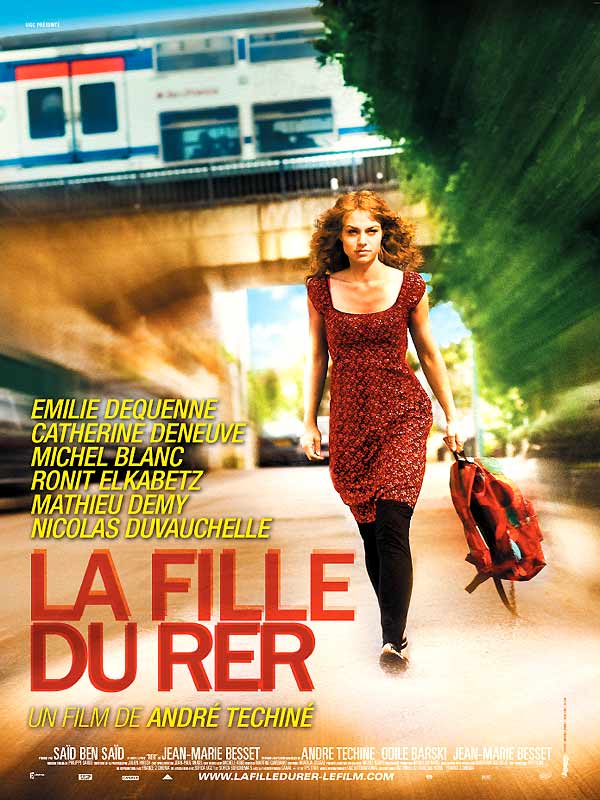
La fille du RER (The Girl on the Train) *


I think I've set the bar pretty high lately, especially for contemporary French films. It's not so much that this was bad -- it wasn't -- but that it was only okay, whereas everything else I've watched lately has been no less than great, and a couple have been inspiring, game-changers.

Some of the characters in this were very real to me, and many were likeable (unfortunately, not our protagonist, but I've sat through less winning characters, so I won't grip about that too much). None of the complex action feels unmotivated, not even the somewhat outlandish centerpiece of the story, in which Jeanne half-heartedly fakes an anti-semitic attack on herself. The problem isn't characters and motivation; for my money, the problem is that it never seems to amount to anything bigger than a collection of scenes. It's based on a real event, and maybe it falls into the all-too-common still-inexcusable trap of so many other films based on real events. That an event really happened isn't enough justification to build a film around. You need to have a reason to tell me this story.

In the end, I left very much with the reaction of "okay, so that all happened." And frankly, that's the worst reaction of all. Deadened, unmoved, unprovoked, and ready to turn away and talk about something else or go do whatever's next. Hate's not the opposite of love, everybody; indifference is.

Seen at the Broadway Multiplex as part of the Portland International Film Festival.