Showing posts with label 3d. Show all posts

12 May 2011

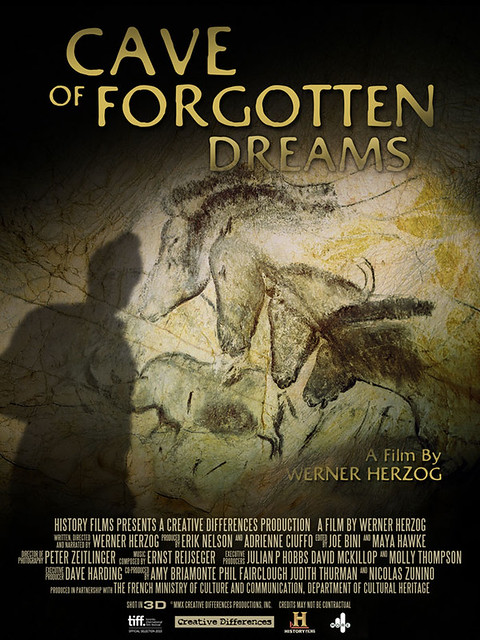
Cave of Forgotten Dreams *


It took me longer than usual to get around to blogging this one, so my reactions aren't as fresh or as sharp as I like, but sometimes that's how it goes. There's a lot to recommend about this film, but most of it you can almost guess before going in. It's a gorgeous and unusual (and totally beautifully appropriate) use of 3D. It's narrated by a madman poet who is singularly able to remain completely unironic and earnest when asking scientists if numbers in a phone directory have souls, or if we are all mutant albino alligators staring at our own doppelgangers through glass. It's profoundly moving and, honestly, a little existentially shaking to be in the presence of 32,000-year-old art and religion. And I think Herzog is completely right to ask bold and awkward questions about the soul: art and religion are inarguably the arenas of the soul, they are our expression of the soul today and their birthplace, whenever that happened exactly, would be the soul's birthplace as well. At least in any meaningful way, as far as this atheist/secular humanist is concerned.

But all of that feels like what almost anyone would say after seeing this film. Some more personal thoughts/reactions I had are to two of the little Herzog tangential thoughts, the notes and anecdotes on the fringe of the cave story. One: I'm surprised, somehow, to find that musical scales haven't changed in 32,000 years -- that the flutes found in other caves use the very same notes and scales we use today. I don't know, I'm not a trained musician but I've taken a class or two, and I know that Eastern musical scales for example are (or were, historically) very different from Western (which I believe is "pentatonic," but rather than look it up I'll just expose my ignorance and half-education here -- I'm just that lazy). I think a lot of people just thought it was a very silly moment when the archaeologist played "The Star-Spangled Banner" on the caveman flute, but the very fact that you can kind of impressed and amazed me.

And two: the story of the aboriginal cave-wall painters touching up thousand-year-old art, and the European anthropologist who asked him why he was painting. The man's answer was that he wasn't painting, that a spirit was painting. It was difficult to determine (or maybe: it is difficult for me to remember) if he literally meant the spirit of the original painter or not, but I took it more as the spirit of the art, or the spirit that inspired the first art, or "the spirit" in a more holistic, non-individualistic sense of spirits -- and that idea I found kind of profoundly moving. In a weird way, that's all (we) artists do with art today, with paintings and narrative and mythology and religion. We see a piece of The Same Old Legends in disarray -- atrophying from lack of attention, from cultural entropy or whatever -- and something moves us to revive it, and paint new lines to fill in the old. Sure, there's more to it, there's that western individualism kicking in, and we feel the vital imperative to season the stew just a little bit, and I'd be lying if I didn't say that adding my voice to the grand story isn't an appealing part of why (we) artists make art. In fact, the ego-centric drive to create art is so strong that I think (we) artists need moments like the aborigine story in Caves to reminded of something grander and far simpler -- that all human art could be viewed as a single tapestry being continually touched up by new hands channeling old spirits.

What struck me strongest in the film was simply the presence of the walls, the caves, the freshness of the art, the profoundness of a window into ancient human history, Herzog's mad-poet voiceover with his matter-of-fact exposition sprinkled with stark humanistic philosophy, and the exciting and justifiable-beyond-merely-dazzle use of 3D, but that all seems like everybody's reaction. Commonalities with our ancestors in music and a connectedness in our storytelling and art that makes me go all Jungian -- those reactions were smaller, more compartmental, but they felt more specific and more fun to rant about.

Seen (in 3D!) at Cinema 21.

29 January 2011

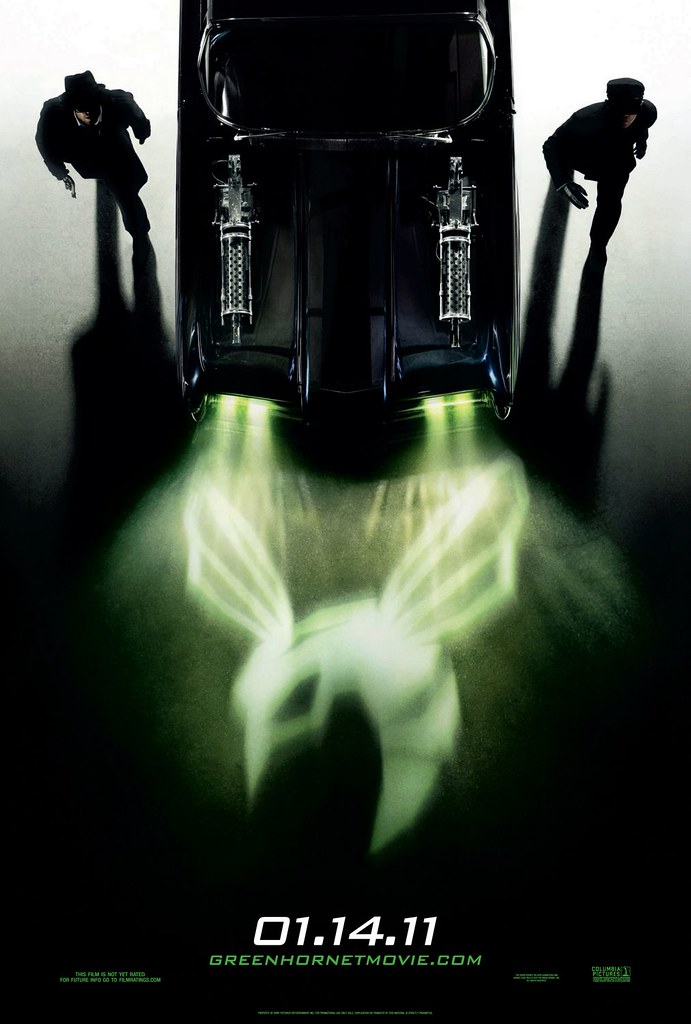
The Green Hornet *


This is a lousy movie. There's just nothing else to say about it. Seth Rogan wrote a lousy movie. Michel Gondry directed a lousy movie. I am shocked at how bad it was, and I would have walked out of the theater had I been seeing it alone (and I never do that -- in fact I've never done it). Rogan's Britt Reid is an unrepentant dickhole who lives in a world of bro-tastic bro-ness, complete with debilitatingly intense gay panic and that weird, acerbic camaraderie entrenched in an ugly loathing for oneself and everyone else in roughly equal measure. It is styleless, toothless, and feckless. Rogan and Jay Chou have zero chemistry. Diaz, Waltz, Wilkinson, and EJO all play thankless, meaningless roles -- more like props than characters, in fact. And I haven't seen this many nutshots in a single movie... ever.

Funny enough I didn't hate it, but almost. I went in expecting it to be bad and it was at least as bad as I'd expected. I have nothing invested in the idea of a good Green Hornet story, though I'm aware enough of the original to see how shoehorning in a frat-boy trustafarian douchebag and a lot of "dude don't be so gay" jokes is egregiously off-key. There were almost no spots that worked, and even less that made the remotest bit of sense. Most of the Gondryisms were half-assed and felt like afterthoughts to a story that didn't call for any -- the only one I even enjoyed was the screen-splitting montage of word-of-mouth, but it was pretty unmotivated and too deaden to be whimsical -- and honestly? That's just an expansion on an effect he'd pretty much already mastered 13 years ago.

The editing, too, deserves a special note for how pointedly lazy it is with the story: a newsroom scene has a bunch of reporters rattle off a list of offenses the Green Hornet has been seen doing over the past few days, which is followed by (not preceded by) a rock-n-roll montage of them doing all those things -- most obviously, shooting out a stoplight-camera. I imagine they decided the scenes worked better in the opposite order, but anyone actually paying the tiniest bit of attention to dialogue would find it a little suspicious that the Hornet seems surprised by the ability to shoot out a stoplight-camera if they'd just done so last night as well. I'm not convinced anyone cared.

I hate to say this -- then again, it's also not the first time I've said it -- Michel Gondry is not a brilliant director without a brilliant script to interpret, and one that calls for his particular skills. This film is neither of those things, even a little bit. Science of Sleep and Be Kind Rewind both play as sloppy messes as films, but as passable entertainment as delivery systems for Gondryesque moments. Human Nature is decent, and of course Eternal Sunshine is a truly gorgeous perfect-storm of talent and style, but The Green Hornet should have been a McG project that nobody paid any attention to or something. At best it might have been doctored and worked into a good movie by David Gordon Green or Jody Hill, maybe. But there's nothing for Gondry here. And Seth Rogan is at least as unlikable here as he is anywhere. This film is... yuck. It's just lousy.

Seen at the Regal Cinemas at Lancaster Mall.

18 December 2010

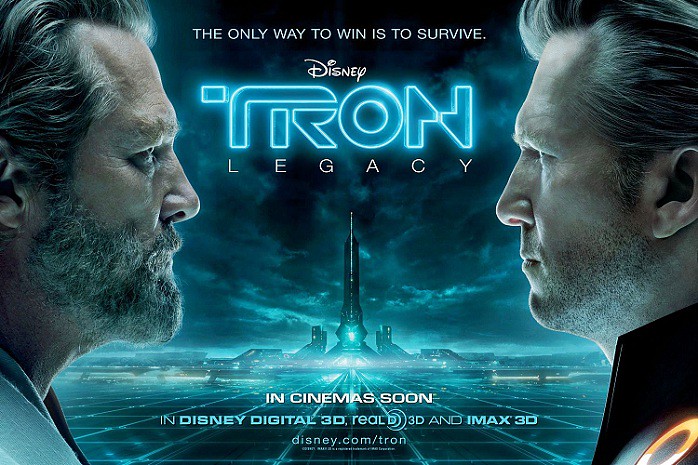
TRON: Legacy *


What worked about TRON: Legacy: For one, the mythology is strong, interesting, dynamic. It's a pretty good evolution of the world. For another, the themes and philosophy are generally strong, in that there are themes and philosophy and they suit the story and, for the most part, the story takes pains to (very lightly) explore them as it goes. For a third, the aesthetic of the world takes a little getting used to (3D is notoriously dimmer than the glasses-free 2D, and for this story to rely on so much endless black with shimmery glass and white neon challenges that a little) but once you do it's pretty good. The world is built well and feels consistent, lived-in, and larger than just the scenes we're given.

What didn't work about TRON: Legacy: In a word, the script. The script does not work. It's like someone took a lot of work structuring your classic hero's journey and building up the protagonists and antagonists on interesting paths, made sure all the beats made sense, and then handed the script to a tenth grader. The characters do just what is needed to keep the story moving but about half of their actions lack any cohesive motivation (most notably [SPOILER] the surprise reveal of TRON and his reversal from bad guy to good guy). The pacing and plot itself stumbles about as often as not and more than once fails to stick a landing (like the weird Ziggy Stardust-Merovingian sequence and the "light-jet" fight). And the dialogue... oh good lord, what dialogue. I can sum up what's wrong with the script with the following exchange, between Quorra (a program, curious about the real world) and Sam Flynn (a user), as they discuss a sunset:
Quorra: "What's it like?"
Sam: "The sun?"
Quorra nods.
Sam: "I've never had to describe it before." (He thinks. The music is soft, thoughtful. They lean close together -- an intimate moment, as he shares his world with her.) "Warm. Radiant. uh... beautiful."
She is clearly moved by this poetic description.
(end of scene.)
It really smacks of an early draft, with placeholder dialogue that nobody ever went back to spruce up. This kind of flimsy exchange is peppered throughout the story, whenever a good kicker of a line or bit of clever back-and-forth is meant to advance the characters or story. It is painfully obvious that nobody even tried.

So on the plus side, we have mythology, theme, and world; on the minus side, dialogue, plot, and characterization. So in fact, TRON: Legacy is actually a perfect sequel to the original. TRON wasn't exactly a perfect film either, in fact. The original was full of heady, exciting concepts I hadn't seen explored much before, like the user-program/god-man parallels and the idea of an infectious self-awareness spreading from Flynn's interruption of business-as-usual in the computer world. The sequel, too, is full of heady, exciting concepts I haven't seen explored much before, like spontaneously self-aware, functionless programs sprouting up inside the Grid, or the strange dynamic between Clu and Flynn. But neither film even tries to go anywhere with these ideas, preferring instead fight sequences, chases, shoot-outs, and shouty confrontations. It's really surprising how much like my reaction to the first TRON film my reaction to this one is. And in that light, though this film is far from perfect, it's kind of hard to fault it much. And so I'm left with: I'm glad I saw it. But I'm not in love. I'm not even sure if I liked it much or not.

Two closing thoughts: One, there's a weird fake-out where Cillian Murphy shows up at the beginning playing the son of David Warner's Ed Dillinger, the villain from TRON, which is a total waste of both Murphy and the legacy of Dillinger (I'd have absolutely loved to see David Warner show up again, in some capacity) since it went nowhere. He sat in a board meeting, proved himself a genius at computers and spoke with an authority that shut up a panicked room, and then never appeared again. (I suppose in retrospect that he is a plant for a third TRON film, which... whatever... but I'd much rather have seen the return of David Warner.)

And lastly: I miss the Bit. It didn't make any more or less sense than anything else; they should have brought it back. Or brought in a Byte, with 16 different possible opinions and no more.

It's been a weak year, overall, for new films. Plenty of very good ones, plenty of "good enough" ones, not much I've seen this year makes me sit up and say, "Oh my god, this is real cinema," the way I have in years past. I think Winter's Bone is the standout on that list.

Seen at the AMC Century City 15, in 3-D.